
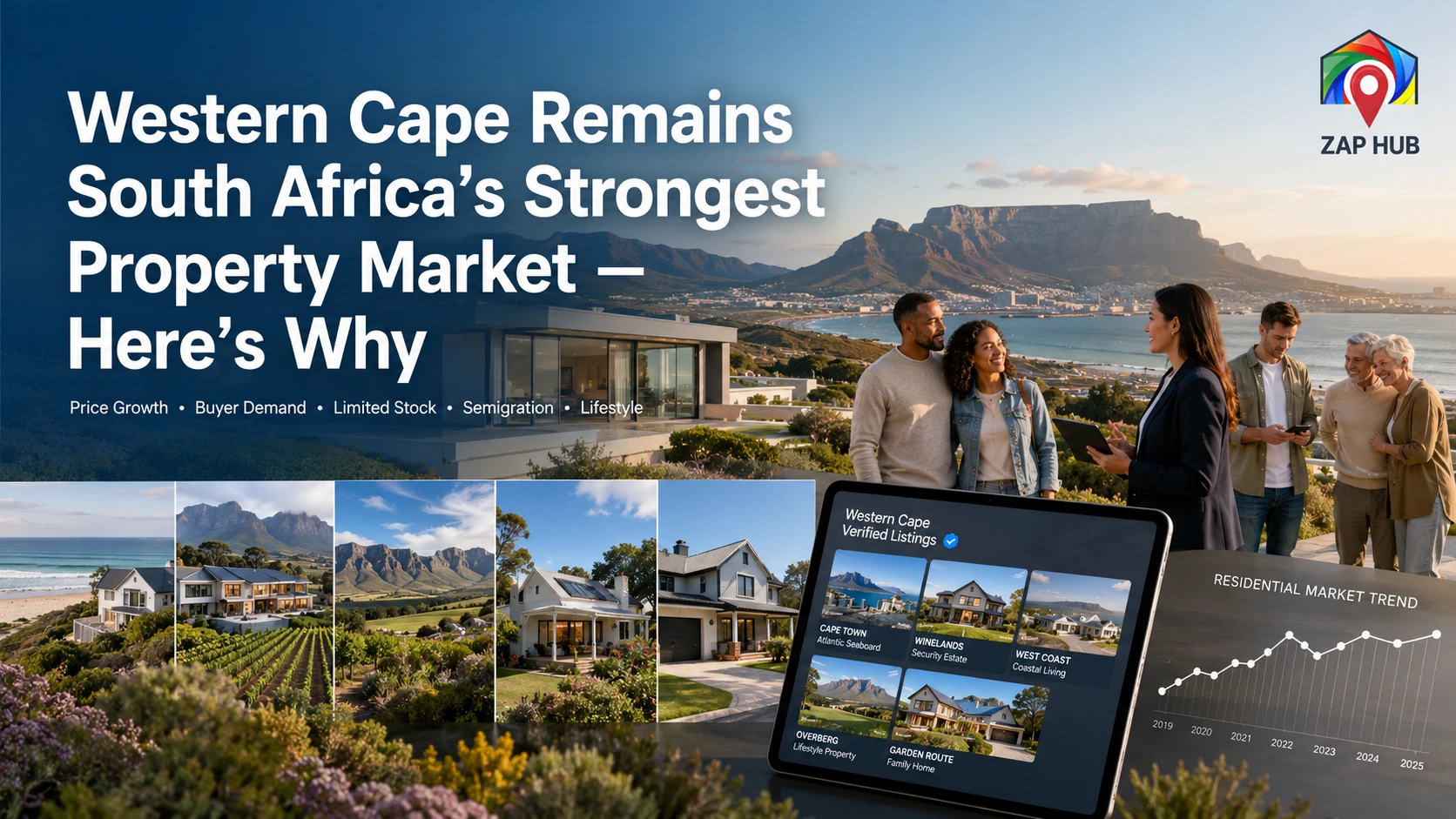
The Western Cape continues to stand out as South Africa’s strongest residential property market in 2026. Its advantage is reflected in sustained house-price growth, demand from semigrants, limited housing stock in desirable areas and continued buyer interest across Cape Town, the Winelands, West Coast, Overberg and Garden Route.
“Strongest” does not mean that every property in the Western Cape is increasing in value or that the province is the best choice for every buyer. It means that the Western Cape has shown comparatively strong price performance, buyer demand and market resilience across recent reporting periods.
Statistics South Africa reported annual national residential property-price inflation of 7.7% in February 2026. The Western Cape remained one of the main contributors to national growth, continuing the province’s strong performance from 2025. In November 2025, the Western Cape recorded annual residential price growth of 9.5%, compared with 4.6% in Gauteng. Cape Town recorded 9.3% growth during the same period.
Buyers can begin by exploring Western Cape properties for sale on ZAP HUB.
What Makes a Property Market Strong?
A strong property market is not defined only by high asking prices.
Important indicators include:
- Sustained price growth
- Consistent buyer demand
- Limited supply in desirable locations
- Rental demand
- Economic and employment activity
- Population growth
- Access to infrastructure
- Resale liquidity
- Confidence in the region
- Demand across several property types and price categories
The Western Cape performs strongly across many of these factors, although conditions still differ between locations.
A luxury apartment on Cape Town’s Atlantic Seaboard, a family home in Durbanville, an estate property in Paarl and a retirement home in Mossel Bay operate within very different micro-markets.
1. Western Cape Property Prices Continue to Outperform
The province’s strongest evidence is its price performance.
Lightstone-based market reporting showed average Western Cape house-price growth of approximately 7.4% during the year to November 2025. This was more than double the reported national average of approximately 3.2% and ahead of KwaZulu-Natal and Gauteng.
Official Stats SA data also recorded Western Cape residential property inflation of 9.5% year-on-year in November 2025, compared with national inflation of 7.1%. Cape Town was the leading metropolitan contributor, recording annual growth of 9.3%.
These provincial figures do not mean that every home increased by the same percentage. Property performance depends on:
- Suburb
- Property type
- Price band
- Condition
- Security
- Views and location
- Development supply
- Municipal services
- Buyer affordability
Nevertheless, the broader trend shows that Western Cape property has maintained stronger momentum than many other provincial markets.
2. Cape Town Remains the Province’s Main Property Engine
Cape Town supports the largest and most diverse residential market in the province.
Its property options include:
- City apartments
- Sectional-title units
- Suburban family homes
- Luxury coastal properties
- Security estates
- Student accommodation
- Retirement developments
- Investment properties
- Short- and long-term rentals
Demand comes from local residents, semigrants, investors, retirees, professionals and selected international buyers.
Popular property markets include:
- City Bowl
- Atlantic Seaboard
- Southern Suburbs
- Northern Suburbs
- Western Seaboard
- Helderberg
- South Peninsula
- Cape Flats
Cape Town’s population increased substantially between the 2011 and 2022 censuses, creating additional pressure on housing and infrastructure. The city’s continuing appeal has helped support property demand but has also contributed to affordability challenges.
Explore Cape Town properties for sale on ZAP HUB.
3. Semigration Continues to Support Demand
Semigration refers to people moving from one South African province or city to another.
The Western Cape continues to attract households from Gauteng, KwaZulu-Natal, the Eastern Cape and other parts of the country. Buyers frequently mention lifestyle, schools, municipal performance, security, employment opportunities and access to outdoor activities as reasons for relocating.
Semigration is not limited to Cape Town. It is also supporting demand in:
- Somerset West
- Stellenbosch
- Paarl
- Wellington
- Langebaan
- Hermanus
- George
- Mossel Bay
- Knysna
- Plettenberg Bay
Housing-market economists expected the Western Cape to remain a leading performer during 2026, supported by migration, limited stock and economic activity.
However, affordability is beginning to influence relocation decisions. Some households are reconsidering the Western Cape because they can obtain substantially larger properties elsewhere for the same budget.
4. Limited Stock Supports Prices in Desirable Areas
Housing supply cannot always increase quickly in Western Cape locations where demand is strongest.
Development may be restricted by:
- Mountains
- Coastlines
- Protected environments
- Agricultural land
- Planning rules
- Infrastructure capacity
- Limited serviced land
- Community objections
- Construction costs
When many buyers compete for a limited number of suitable properties, prices may remain supported even when the broader economy is under pressure.
This is particularly relevant in established areas such as:
- Cape Town’s City Bowl
- Atlantic Seaboard
- Southern Suburbs
- Durbanville
- Somerset West
- Stellenbosch
- Paarl
- Hermanus
- Knysna
- Plettenberg Bay
Limited supply does not guarantee appreciation. A property can still be overpriced, poorly maintained or unsuitable for the local buyer market.
5. The Western Cape Offers Several Strong Regional Markets
The province is not dependent entirely on Cape Town.
Cape Winelands
Stellenbosch, Paarl, Franschhoek and Wellington attract families, students, professionals, retirees and lifestyle buyers.
The region offers:
- Security estates
- Family homes
- Student accommodation
- Farms and smallholdings
- Retirement properties
- Luxury lifestyle homes
Access to schools, universities, tourism, agriculture and commercial development supports several forms of residential demand.
West Coast
Langebaan, Yzerfontein, St Helena Bay, Saldanha, Paternoster and Velddrif attract coastal buyers, retirees, remote workers and holiday-property purchasers.
The West Coast may offer a different entry point from Cape Town, although development supply, water availability, employment and seasonal demand should be investigated carefully.
Overberg
Hermanus, Onrus, Kleinmond, Betty’s Bay, Stanford, Gansbaai, Caledon and surrounding towns appeal to retirees, semigrants and lifestyle buyers.
Hermanus has developed into an important permanent residential market rather than functioning solely as a holiday destination.
Explore Overberg properties for sale on ZAP HUB.
Garden Route
George, Mossel Bay, Knysna, Plettenberg Bay, Wilderness and Sedgefield remain prominent semigration and retirement destinations.
George and Mossel Bay combine established infrastructure with coastal access, schools, healthcare, airports and secure estates.
This regional diversity reduces the province’s dependence on a single buyer group or property category.
6. Lifestyle Demand Supports Long-Term Buyer Interest
Many Western Cape purchasers are not motivated only by short-term financial returns.
They may be buying for:
- Coastal living
- Retirement
- Schools
- Outdoor recreation
- Remote work
- Access to nature
- Family relocation
- Lower-density living
- Estate security
- Long-term residence
Lifestyle-driven buyers may hold properties for longer periods and may be less likely to sell because of short-term market fluctuations.
This can support market stability, particularly where buyers have strong emotional and practical reasons for choosing a location.
Lifestyle appeal should not replace financial discipline. Buyers must still compare price, ownership expenses, property condition and resale prospects.
7. Secure Estates Remain Highly Attractive
Security-estate living is an important component of Western Cape demand.
Buyers are attracted by:
- Controlled access
- Maintained public areas
- Recreational facilities
- Architectural standards
- Walking and cycling routes
- Family-friendly amenities
- Fibre connectivity
- Community environments
- Backup utilities in selected developments
Popular estate markets can be found around:
- Durbanville
- Somerset West
- Stellenbosch
- Paarl
- Wellington
- Hermanus
- George
- Mossel Bay
Estate properties can command premiums, but buyers should carefully examine:
- Monthly levies
- Special levies
- Homeowners’ association finances
- Conduct rules
- Building requirements
- Letting restrictions
- Development phases
- Maintenance obligations
- Future supply
An attractive estate is not automatically an affordable or profitable investment.
8. Rental Demand Remains Strong in Selected Nodes
Western Cape rental demand is supported by students, professionals, semigrants, seasonal workers, tourists and households unable to afford property purchases.
Important rental markets include:
- Cape Town City Bowl
- Atlantic Seaboard
- Southern Suburbs
- Century City
- Bellville
- Durbanville
- Stellenbosch
- Somerset West
- George
- Mossel Bay
Rental demand can support investors, but Western Cape purchase prices are often high relative to monthly rent.
An investor should calculate:
Annual rent ÷ Purchase price × 100
This produces a gross rental yield. It does not account for:
- Levies
- Municipal rates
- Insurance
- Management fees
- Vacancy
- Maintenance
- Finance costs
- Tax
- Furniture
- Short-term rental expenses
High capital growth and high rental yield do not always occur in the same area.
9. Municipal Performance Influences Buyer Confidence
Property buyers increasingly evaluate the municipality as well as the home.
They may consider:
- Water reliability
- Electricity infrastructure
- Road maintenance
- Refuse collection
- Municipal billing
- Planning enforcement
- Public spaces
- Emergency services
- Infrastructure investment
- Development management
Perceptions of comparatively stronger municipal performance in parts of the Western Cape have contributed to buyer confidence.
However, performance is not equal across all municipalities or neighbourhoods. Buyers should investigate the specific area rather than assuming that every Western Cape town provides the same service levels.
10. Remote Work Has Expanded the Property Map
Remote and hybrid work have made it possible for some professionals to live farther from Cape Town’s central employment areas.
This has supported demand in towns that provide:
- Reliable fibre
- Mobile connectivity
- Schools
- Healthcare
- Retail
- Airport access
- Safe working environments
- Outdoor lifestyles
- Backup electricity options
Locations benefiting from this trend include:
- Somerset West
- Paarl
- Hermanus
- Langebaan
- George
- Mossel Bay
- Knysna
- Plettenberg Bay
Remote workers should confirm connectivity at the individual property. Internet quality can differ between neighbourhoods and even between homes in the same development.
11. The Province Appeals to Several Buyer Groups
Western Cape property demand does not come from one type of purchaser.
The market includes:
- First-time buyers
- Families
- Semigrants
- Retirees
- Investors
- Students and parents
- Holiday-home buyers
- Remote professionals
- Returning South Africans
- International buyers in selected markets
This broad demand base supports different property categories.
A slowdown in one segment may therefore be partly offset by activity elsewhere, although premium and entry-level markets can move in very different directions.
12. Affordability Is the Western Cape’s Greatest Weakness
The province’s strength has contributed to its biggest challenge: high property prices.
BetterBond reported an average Western Cape selling price of approximately R2.26 million over the 12 months to January 2026. This broad figure covers very different markets and should not be treated as the expected price in every town or suburb.
Other Q1 2026 reporting placed the province’s average property price significantly above the national average, highlighting the affordability gap facing local and incoming buyers.
Affordability pressure may cause buyers to:
- Purchase smaller homes
- Choose apartments or townhouses
- Move farther from Cape Town
- Consider secondary towns
- Rent instead of buying
- Buy jointly
- Increase deposits
- Delay purchasing
- Relocate to another province
A strong market can therefore create opportunities for current owners while excluding first-time and middle-income buyers.
13. Western Cape Property Is Not Risk-Free
Strong historical performance does not remove investment risk.
Buyers should consider:
- High entry prices
- Transfer and finance costs
- Lower rental yields in premium areas
- Coastal corrosion
- Wildfires
- Flooding and stormwater
- Water availability
- High estate levies
- Short-term rental restrictions
- Seasonal demand
- Development oversupply
- Infrastructure pressure
- Municipal rates
- Climate-related insurance costs
Environmental due diligence is particularly important for coastal, mountain, rural and lifestyle properties.
Buyers may need to investigate firebreaks, evacuation access, drainage, retaining structures, erosion, boreholes, septic systems and insurance availability.
14. Interest Rates Still Shape Affordability
The South African Reserve Bank’s policy rate stood at 7% in late July 2026, with the prime lending rate at 10.5%. Financing therefore remains a significant consideration despite the province’s strong property performance.
Before buying, calculate:
- Monthly bond repayments
- Transfer expenses
- Bond-registration costs
- Municipal rates
- Levies
- Insurance
- Maintenance
- Security
- Commuting
- Water and energy backup
- Possible repayment increases
Use the ZAP HUB bond calculator and affordability calculator for initial planning. Final finance terms must be confirmed with the lender or bond professional.
What Should Western Cape Buyers Check?
Before purchasing:
- Compare recent registered sales.
- Confirm total transfer and finance costs.
- Check municipal rates and levies.
- Review estate or body-corporate finances.
- Arrange an independent inspection.
- Confirm approved building plans.
- Investigate water and electricity arrangements.
- Assess wildfire, flood and coastal risks.
- Verify internet connectivity.
- Review local rental demand where investing.
- Visit the area outside peak holiday periods.
- Avoid buying solely because the province is performing strongly.
Buyers can use the ZAP HUB service-provider search to find inspectors, conveyancers, valuers, electricians, plumbers, waterproofing professionals and other property specialists.
What Should Western Cape Sellers Know?
Strong demand does not guarantee an immediate sale at any price.
Sellers should:
- Obtain a suburb-specific market assessment
- Compare registered sales
- Calculate expected net proceeds
- Repair active defects
- Complete disclosure documents honestly
- Confirm municipal and levy accounts
- Prepare approved plans
- Arrange compliance inspections
- Understand bond-cancellation requirements
- Use professional property photography
- Price according to market evidence
- Respond promptly to qualified buyers
Correctly priced and well-maintained homes are more likely to stand out, even in a strong provincial market.
Is the Western Cape Still South Africa’s Strongest Property Market?
Based on recent price growth, buyer demand and regional momentum, the Western Cape continues to have a strong claim to that position in 2026.
Its advantages include:
- Sustained price appreciation
- Cape Town’s large buyer market
- Semigration
- Lifestyle demand
- Limited stock in desirable areas
- Strong regional towns
- Estate development
- Rental demand
- Municipal confidence in selected locations
- Long-term owner-occupier appeal
Its disadvantages include high prices, affordability pressure and environmental and infrastructure risks.
The province may be strongest for capital growth and lifestyle demand, but Gauteng may offer better affordability or rental yields in selected areas. KwaZulu-Natal may provide coastal alternatives at lower entry prices.
The right province depends on the buyer’s objective.
Final Thoughts
The Western Cape remains South Africa’s strongest residential property market because its success is supported by more than one trend.
Cape Town provides economic scale and international visibility. The Winelands offers schools, estates and lifestyle living. The West Coast, Overberg and Garden Route attract semigrants, retirees and remote workers. Limited stock in highly desirable locations continues to support prices.
The strongest provincial market is not automatically the safest individual purchase. Buyers must still evaluate the property, location, condition, affordability and ownership expenses.
Explore Western Cape properties for sale on ZAP HUB and compare opportunities according to your budget, intended use and long-term goals.
- Western Cape properties for sale
https://zaphub.co.za/residential-properties-for-sale/south-africa/western-cape - Cape Town properties for sale
https://zaphub.co.za/residential-properties-for-sale/south-africa/western-cape/cape-town - Overberg properties for sale
https://zaphub.co.za/residential-properties-for-sale/south-africa/western-cape/overberg - Search property-service providers
https://zaphub.co.za/service-providers/search - Browse service-provider categories
https://zaphub.co.za/service-providers/categories - Bond calculator
https://zaphub.co.za/bond-calculator - Affordability calculator
https://zaphub.co.za/affordability-calculator
Frequently Asked Questions
1. Is the Western Cape South Africa’s strongest property market?
Recent official and industry data show that the Western Cape has recorded stronger price growth than several other provinces, supporting its position as a leading residential market.
2. Why is Western Cape property performing strongly?
Important drivers include semigration, lifestyle demand, limited stock, Cape Town’s economy, regional growth and continued interest in coastal and estate properties.
3. Are property prices still increasing in the Western Cape?
Yes. Recent Stats SA data showed strong annual Western Cape property-price inflation, although growth varies by location and property type.
4. Is Cape Town the strongest metropolitan property market?
Cape Town has been one of the strongest metropolitan contributors to national residential property-price growth, but individual suburbs perform differently.
5. Which Western Cape areas are growing?
Demand is visible in Cape Town, Somerset West, Stellenbosch, Paarl, Langebaan, Hermanus, George, Mossel Bay and other selected lifestyle markets.
6. Is Western Cape property affordable?
Affordability is a significant challenge. Average prices are higher than in many other provinces, particularly in Cape Town and premium lifestyle locations.
7. Is the Western Cape suitable for first-time buyers?
Yes, but buyers may need to consider apartments, townhouses, peripheral suburbs or regional towns rather than premium Cape Town locations.
8. Is the Garden Route still attracting semigrants?
Yes. George, Mossel Bay, Knysna and Plettenberg Bay remain prominent relocation and retirement destinations.
9. Is Western Cape property a good investment?
It may suit investors seeking long-term growth and strong owner-occupier demand. High entry prices, levies and potentially lower rental yields must still be considered.
10. Does Western Cape property guarantee appreciation?
No. Provincial performance does not guarantee that an individual property will increase in value.
11. Are Western Cape rentals profitable?
Some locations have strong rental demand, but profitability depends on the purchase price, rent, vacancy, levies, rates, finance and maintenance.
12. What risks should coastal buyers investigate?
Buyers should assess corrosion, damp, waterproofing, wind exposure, flooding, erosion, drainage, insurance and maintenance costs.
13. What should estate buyers check?
Review levies, special levies, conduct rules, reserve funds, building guidelines, letting restrictions and future development phases.
14. Where can I find Western Cape property professionals?
Use the ZAP HUB service-provider search to find professionals by category and operating location.
Call to Action
Explore South Africa’s Leading Property Market
Compare houses, apartments, townhouses, secure estates, coastal homes, retirement properties and investment opportunities across the Western Cape.
Browse Western Cape Properties on ZAP HUB
Need Help Before Buying, Selling or Investing?
Find professionals who may assist with:
- Property valuations
- Conveyancing
- Bond applications
- Property inspections
- Electrical compliance
- Plumbing
- Roofing and waterproofing
- Solar and backup systems
- Property management
- Moving services
Search ZAP HUB Service Providers
Disclaimer
This article provides general property-market information and does not constitute financial, investment, legal, lending, tax, valuation or property advice. “Strongest property market” is an editorial description based on recent comparative price growth, buyer demand and market resilience. It does not mean that every Western Cape property will increase in value or outperform properties elsewhere. Market conditions, interest rates, prices, rental income and municipal services may change. Buyers and sellers should obtain current advice from qualified property practitioners, conveyancers, lenders, valuers, inspectors and financial professionals. ZAP HUB does not guarantee property appreciation, rental returns, finance approval, municipal performance or investment outcomes.