
A property listing now has only a few seconds to persuade a buyer to stop scrolling, explore the home and make contact.
Professional photographs remain essential, but photographs alone cannot fully communicate how rooms connect, whether the layout suits a family or how it feels to move through the property.
That is where a 3D virtual tour becomes valuable.
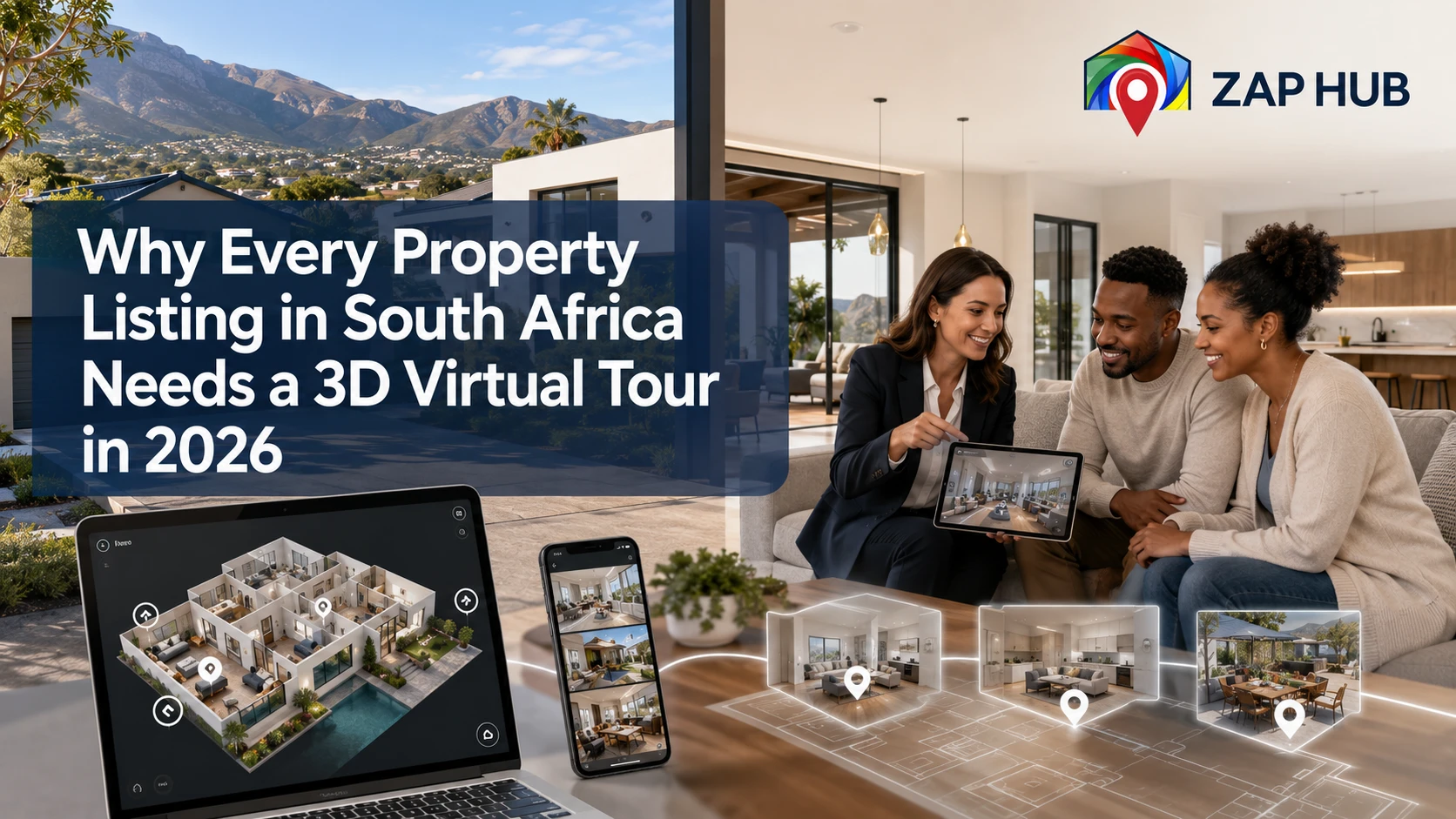
A well-produced 3D tour allows prospective buyers and tenants to move digitally through a home, inspect rooms from different angles, understand the floor plan and revisit the property at any time.
In South Africa’s increasingly digital real-estate market, this matters for buyers searching:
- From another province
- From another country
- During working hours
- Before relocating
- Across several suburbs
- Without time for unnecessary viewings
- For investment property
- For holiday or retirement homes
- For high-value or specialised properties
Property24 has highlighted the growth of virtual walk-throughs in South African property marketing, noting that tours give prospective buyers greater insight into a home before they invest time in an in-person viewing.
By 2026, a 3D virtual tour should no longer be viewed as a premium extra reserved for luxury mansions.
It should be treated as part of a complete digital listing—alongside professional photography, an accurate description, a floor plan, location information and verified property details.
However, the title requires an important qualification.
Not every listing requires the most expensive scanning package available, and a virtual tour cannot compensate for poor pricing, weak photography, misleading information or an unattractive property.
The strongest listing combines several elements:
- Accurate property information
- Professional photographs
- A navigable 3D tour
- A floor plan
- A compelling but honest description
- Clear contact details
- Responsive follow-up from the property practitioner
A virtual tour strengthens the marketing package. It does not replace the fundamentals.
What Is a 3D Virtual Property Tour?
A 3D virtual tour is an interactive digital representation of a property that allows a user to move through the rooms online.
Depending on the technology used, the viewer may be able to:
- Walk from one room to another
- Look up, down and around
- Zoom in on property features
- Switch between floors
- View a dollhouse-style model
- Access a floor plan
- Measure spaces
- Open information labels
- Explore outdoor areas
- Use the tour on a phone, tablet, laptop or virtual-reality device
The tour is normally created by capturing multiple panoramic or spatial scans throughout the property and linking them into one navigable experience.
Matterport and similar platforms use spatial-capture technology to create digital representations of real environments. The resulting model can show the layout and relationship between rooms more clearly than a collection of separate images.
A 3D Tour Is Not the Same as a Property Video
The terms are often used interchangeably, but the formats serve different purposes.
Property video
A property video follows a route selected by the videographer or agent.
The viewer watches what the creator chooses to show and in the order selected.
Videos are particularly useful for:
- Social media
- Emotional storytelling
- Lifestyle presentation
- Agent introductions
- Aerial footage
- Short promotional campaigns
- Highlighting premium features
3D virtual tour
A 3D tour gives the viewer control.
The user can decide:
- Which room to enter
- How long to remain there
- Which details to inspect
- Whether to revisit a room
- How spaces connect
- Whether the layout suits their needs
360-degree tour
A 360-degree tour links panoramic images together. It may provide an effective walkthrough without constructing a complete spatial model.
Best practice
The most complete marketing package may include:
- Professional photographs
- A 3D or 360-degree tour
- A floor plan
- A short property video
- Drone photography where legally and practically appropriate
Each format contributes something different.
Why Buyer Behaviour Has Changed
Property search increasingly begins online rather than at an estate agency office.
Buyers and tenants expect to:
- Search by suburb
- Filter by price
- Compare property types
- View photographs
- Check maps
- Read descriptions
- Calculate affordability
- Contact practitioners digitally
- Save or share listings
- Review properties outside business hours
South African property commentary has identified instant online access, virtual tours, neighbourhood information and mobile-friendly tools as growing buyer expectations.
A purchaser may assess dozens of listings before contacting a property practitioner.
That means the online listing is no longer merely an advertisement encouraging someone to ask for more information.
For many buyers, the listing is the first viewing.
Why Photographs Alone Are No Longer Enough
Professional photographs remain one of the most important parts of a property listing. Property24 advises sellers and agents to use well-lit, high-resolution images and to prepare the property carefully before photography.
But photographs have limitations.
A photograph can make a room look attractive without showing:
- How the room connects to the passage
- Whether the kitchen is open-plan
- The distance between bedrooms
- Where the bathroom is positioned
- Whether a staircase is steep
- How natural light moves through the home
- Whether furniture placement is practical
- How indoor and outdoor spaces connect
- Whether the floor plan suits a multigenerational family
Wide-angle lenses can also make rooms appear larger than they are.
A well-produced 3D tour reduces uncertainty by allowing the viewer to explore the complete layout.
3D Tours Help Buyers Understand Flow
“Flow” is difficult to communicate through still images.
A listing may include beautiful photographs of:
- A lounge
- A kitchen
- A dining room
- A patio
- Three bedrooms
Yet the buyer may still not understand how those spaces relate to one another.
A virtual walkthrough can answer questions such as:
- Does the kitchen connect directly to the dining area?
- Can the living room open onto the garden?
- Are children’s bedrooms close to the main bedroom?
- Is the guest bedroom private?
- Does the home office have a separate entrance?
- Can elderly family members avoid stairs?
- Is the bathroom accessible from the entertainment area?
- Does the flatlet connect to the main house?
Understanding these relationships helps buyers decide whether the property deserves an in-person viewing.
Virtual Tours Produce More Informed Enquiries
A high number of enquiries is not always the best measure of listing performance.
The more important question is whether the enquiries come from people who understand the property and have a realistic chance of purchasing or renting it.
A virtual tour can help prospective buyers self-qualify.
Before contacting the agent, they can assess:
- Layout
- Room proportions
- Condition
- Finishes
- Number of levels
- Outdoor space
- Parking
- Privacy
- Renovation requirements
- Suitability for children or pets
This may reduce enquiries from people who would immediately reject the property after arriving.
South African guidance on virtual walk-throughs identifies convenience and better pre-viewing insight as important benefits for buyers and property professionals.
Fewer Unproductive Physical Viewings
Every viewing requires time and coordination.
The process may involve:
- Contacting the seller
- Confirming access
- Preparing the property
- Travelling to the property
- Opening gates or security estates
- Managing pets
- Rearranging family routines
- Waiting for prospective buyers
- Following up after the appointment
When the property is tenanted, the viewing may be even more disruptive.
A 3D tour allows a buyer to conduct an initial digital inspection before requesting physical access.
The in-person viewing can then focus on:
- Natural light
- Noise
- Neighbourhood conditions
- Structural condition
- Finishes
- Views
- Security
- Emotional connection
This improves efficiency for the seller, buyer, tenant and property practitioner.
Better Access for Interprovincial Buyers
South Africa has a substantial relocation and semigration market.
Buyers may be moving between:
- Gauteng and the Western Cape
- KwaZulu-Natal and Gauteng
- Johannesburg and the Garden Route
- Cape Town and the Overberg
- Durban and the KZN Midlands
- Large metros and smaller towns
A Gauteng buyer considering a home in George, Hermanus or Gansbaai may not be able to travel for every possible property.
A Cape Town family relocating to Johannesburg may need to shortlist homes before arranging one intensive viewing trip.
A 3D tour allows these buyers to compare properties remotely and reserve physical viewings for their strongest options.
International Buyers Can View South African Property Remotely
South African property attracts:
- Returning expatriates
- Foreign investors
- Holiday-home buyers
- Retirees
- International executives
- South Africans working abroad
- Families relocating home
Time zones, travel costs and visa arrangements can delay physical inspections.
A detailed digital tour enables these purchasers to:
- Explore the home remotely
- Share it with family
- Consult an architect or designer
- Compare the layout with alternatives
- Review it repeatedly
- Make a more informed decision before travelling
A virtual tour does not remove the need for professional inspections, legal due diligence or independent representation.
It does help remote buyers decide whether the property belongs on their serious shortlist.
Why 3D Tours Matter for South African Sellers
For a seller, the principal advantage is improved presentation.
A complete virtual tour may help the property:
- Stand out among similar listings
- Hold buyer attention for longer
- Demonstrate its layout clearly
- Reach remote buyers
- Reduce unnecessary appointments
- Support premium marketing
- Present renovations properly
- Generate more informed enquiries
- Remain viewable at any time
Matterport cites research associating listings containing 3D tours with stronger engagement and, in some datasets, faster transactions or higher selling prices. These findings are not specific to every South African suburb and should not be treated as guaranteed results.
The correct conclusion is not that adding a tour guarantees a faster sale.
It is that immersive visual content can strengthen a well-priced and professionally marketed listing.
Why Property Practitioners Need the Technology
A 3D tour benefits more than the individual property.
It can improve how an agency or practitioner presents its service to sellers.
During a listing presentation, the practitioner can demonstrate that the marketing plan includes:
- Professional photography
- Digital walkthroughs
- Portal distribution
- Social-media content
- Database promotion
- Buyer qualification
- Performance reporting
- Follow-up systems
Virtual-tour technology can help a practitioner differentiate the service offered from competitors relying only on photographs and brief descriptions.
Matterport has promoted 3D-tour technology as a way for agents to strengthen listing presentations and increase buyer interest, although performance varies by market, price point and implementation.
The Listing Remains Open 24 Hours a Day
A physical property viewing depends on:
- Seller availability
- Practitioner availability
- Daylight
- Security access
- Tenant cooperation
- Travel
- Weather
- Working hours
A virtual tour can be accessed at:
- Early morning
- During a lunch break
- In the evening
- Over a weekend
- From another city
- From another country
This matters because many buyers conduct property research after work.
The listing continues presenting the home even when the agent is unavailable.
Buyers Can Revisit the Property
During a physical viewing, a buyer may forget important details.
They may remember the kitchen but not:
- The passage width
- The bedroom cupboards
- The second bathroom
- The position of the garage
- The shape of the garden
- The relationship between the cottage and main house
A 3D tour allows the buyer to return to the property digitally.
They can review it with:
- A partner
- Parents
- Children
- An architect
- An interior designer
- A building inspector
- A business partner
- A financial adviser
This can support a more considered decision.
Floor Plans and Measurements Improve Practical Decision-Making
Some 3D-tour platforms can generate schematic floor plans or allow approximate measurements.
This can help buyers assess:
- Whether existing furniture will fit
- Whether a bedroom can accommodate a desk
- Whether a wall could potentially be altered
- How much flooring may be needed
- Whether rooms suit mobility requirements
- Whether a sectional-title unit has sufficient usable space
Measurements generated from digital tours should not be used as a substitute for professional architectural, cadastral or construction measurements.
They are useful for preliminary planning.
Which Property Types Benefit Most?
Residential Houses
Freestanding houses often contain several connected spaces:
- Multiple bedrooms
- Entertainment rooms
- Garages
- Patios
- Gardens
- Cottages
- Studies
- Separate entrances
A virtual tour helps buyers understand the complete arrangement.
Apartments
For apartments, layout efficiency is particularly important.
Buyers may want to understand:
- Whether the bedrooms are separated
- How much natural light enters the unit
- Whether the balcony connects to the lounge
- How the kitchen is arranged
- Whether furniture will fit
- Whether the unit feels cramped
A virtual tour can make a compact but well-designed apartment more appealing.
Townhouses and Estate Homes
Many townhouse complexes contain units with similar specifications.
A tour helps demonstrate:
- Private-garden size
- Garage access
- Guest-toilet position
- Staircase layout
- Entertainment flow
- Bedroom privacy
- Storage
It can distinguish one unit from competing listings.
Luxury Property
High-value buyers often expect a more complete digital presentation.
Luxury properties may include:
- Multiple reception areas
- Wine cellars
- Gyms
- Home cinemas
- Guest suites
- Staff accommodation
- Entertainment wings
- Large gardens
- Multiple levels
- Special architectural details
A 3D tour allows the listing to present these features cohesively.
Farms and Smallholdings
Rural properties may contain:
- A main residence
- Cottages
- Barns
- Workshops
- Guest accommodation
- Offices
- Agricultural buildings
- Entertainment areas
Separate tours or connected digital spaces can help buyers understand the built infrastructure.
Aerial photographs and maps should complement the interior tour because a 3D scan cannot fully represent the entire landholding.
New Developments
Developers can use 3D tours to present:
- Completed show units
- Different unit types
- Common facilities
- Clubhouses
- Apartment layouts
- Finishes
- Views
- Lifestyle features
Where a unit has not yet been built, computer-generated walkthroughs must be clearly identified as artist impressions rather than completed property.
Rental Properties
Tenants also benefit from understanding the property before arranging a viewing.
Virtual tours can be particularly helpful for:
- Corporate relocations
- Student accommodation
- Executive rentals
- Holiday homes
- Long-distance tenants
- Furnished apartments
- Properties with high enquiry volumes
Landlords may benefit from fewer unsuitable viewing appointments.
Commercial and Industrial Property
The principle extends beyond residential listings.
Business tenants or purchasers may use virtual tours to assess:
- Office layouts
- Warehouses
- Showrooms
- Retail premises
- Reception areas
- Boardrooms
- Storage
- Loading spaces
- Workshops
Commercial users still need site visits for operational and technical due diligence, but the tour can support initial shortlisting.
Why Mobile Performance Is Essential
A technically impressive virtual tour is ineffective when it:
- Loads slowly
- Requires unusual software
- Uses too much mobile data
- Is difficult to navigate
- Opens in an unstable window
- Contains unreadable controls
- Does not work on common devices
South African users access listings across different devices, connection speeds and data plans.
A good tour should therefore:
- Load progressively
- Work on mobile
- Provide clear controls
- Offer a full-screen option
- Avoid unnecessary effects
- Include a fallback gallery
- Remain accessible when the user declines virtual-reality mode
The aim is convenience, not technological complexity.
What Makes a Good 3D Tour?
The property is prepared properly
Before scanning, the home should be:
- Clean
- Decluttered
- Well lit
- Neatly staged
- Free from unnecessary personal documents
- Organised consistently
- Prepared indoors and outdoors
Because the tour shows the property from many angles, objects that might be hidden from a photographer can remain visible.
The scan path is logical
The viewer should be able to move naturally through the home.
Poorly connected scan points can make the experience confusing.
Lighting is consistent
Dark rooms, blown-out windows and strong light changes reduce quality.
Mirrors and reflective surfaces are checked
Cameras, photographers or private information may appear in mirrors and reflective objects.
Personal information is removed
The tour should not expose:
- Family photographs where privacy is a concern
- Identity documents
- Alarm details
- Security codes
- Computer screens
- Vehicle registrations
- Financial papers
- School information
- Children’s personal details
- Keys or access controls
Important features are labelled carefully
Information tags may identify:
- Appliance brands
- Solar systems
- Smart-home features
- Boreholes
- Water tanks
- Imported finishes
- Security features
- Renovation details
Labels should inform rather than overwhelm.
Privacy and Security Must Be Taken Seriously
A virtual tour provides detailed information about a property.
That creates privacy and security responsibilities.
Before publication, sellers and practitioners should review whether the tour reveals:
- Alarm-panel locations
- Safe locations
- Security weaknesses
- Keys
- Access tags
- Personal photographs
- Family names
- Valuable collections
- Sensitive documents
- Children’s information
- Security-camera blind spots
- Vehicle number plates
Sensitive spaces may need to be:
- Excluded
- Blurred
- Rescanned
- Access-restricted
- Presented only to verified buyers
A seller should understand where the tour will appear, who can access it and how long it will remain hosted.
Occupied and Tenanted Properties Require Consent
A seller may own the property, but occupants still have privacy interests.
Before scanning a tenanted or occupied property, practitioners should coordinate:
- Access
- Consent
- Removal of private items
- Protection of personal information
- Suitable appointment times
- Publication scope
The tour should not expose an occupant’s belongings carelessly.
After the property is sold or withdrawn, the agency should have a process for removing or restricting public access to the tour.
A Virtual Tour Must Be Honest
The purpose of a 3D tour is to provide transparency.
Practitioners should not use scanning or editing techniques to:
- Remove permanent defects
- Hide structural damage
- Misrepresent room size
- Add views that do not exist
- Replace actual finishes
- Remove neighbouring buildings
- Conceal incomplete construction
- Present staged furniture as included in the sale
- Combine separate properties into one misleading tour
Virtual staging may be used to show possibilities, but it should be identified clearly.
Artificial intelligence can assist with presentation, but it must not create a materially false impression of the property.
3D Tours and Artificial Intelligence
The next phase of virtual property marketing is likely to combine spatial tours with AI tools.
Emerging applications include:
- Automated room descriptions
- Suggested tour routes
- Object and feature recognition
- Virtual furnishing
- Renovation visualisation
- Search based on property features
- Automated video creation
- Accessibility summaries
- Multilingual narration
- Interactive property assistants
Recent research has explored systems that generate spatially aware property videos and descriptions from collections of images and reconstructed 3D environments.
This may make immersive content faster and more affordable to produce.
The property professional must still verify that automatically generated information is accurate.
Virtual Tours Can Strengthen Google Discover and Social Content
The tour itself may not appear directly in every discovery surface, but it can generate related assets such as:
- Short walkthrough videos
- Room clips
- Screenshots
- Dollhouse views
- Floor-plan graphics
- Social-media teasers
- Agent-led explanations
- Before-and-after renovation content
These assets can help market the property across:
- TikTok
- YouTube
- Email campaigns
- Agency websites
- Property portals
The complete tour should remain connected to the primary listing page.
How Much Does a 3D Tour Cost in South Africa?
Pricing depends on:
- Property size
- Location
- Number of floors
- Outdoor areas
- Travel
- Hosting period
- Floor-plan requirements
- Photography
- Video editing
- Drone content
- Information tags
- Number of linked buildings
A South African service provider currently advertises Matterport packages beginning at approximately R1,200 for properties up to 300 square metres and approximately R1,800 for properties between 300 and 500 square metres, including additional visual assets and one year of hosting. These are provider-specific advertised rates, not national averages.
Practitioners should obtain current quotations and confirm:
- Whether VAT is included
- Hosting duration
- Renewal costs
- Ownership of the tour
- Download options
- Portal compatibility
- Floor-plan inclusion
- Image rights
- Turnaround time
- Rescanning costs
Is the Cost Justified for Lower-Priced Properties?
The value of a virtual tour should not be assessed only against the selling price.
A lower-priced property may receive many enquiries and require significant time to manage.
A tour may reduce:
- Repeated basic questions
- Unproductive appointments
- Travel
- Disruption to occupants
- Time spent explaining the layout
A modest townhouse, apartment or starter home may benefit as much as a luxury property because its buyers are often highly comparison-driven.
The production method can be matched to the listing budget.
Not every home requires:
- Drone footage
- Cinematic video
- Voice narration
- Complex virtual staging
- High-end architectural production
A clean, accurate and mobile-friendly walkthrough may be sufficient.
Does Every Property Literally Need a Tour?
There may be exceptions.
A complete 3D tour may be less practical for:
- Vacant land
- Properties requiring confidentiality
- Certain distressed sales
- Unsafe or structurally unstable buildings
- Listings where occupants do not consent
- Properties being marketed before construction
- Highly sensitive security properties
- Very short-term listings where scanning cannot be arranged
Alternative visual content may include:
- Drone imagery
- Interactive maps
- Site plans
- Floor plans
- Video walkthroughs
- Restricted-access tours
- Computer-generated models clearly labelled as such
The broader principle remains valid: every serious listing should provide enough digital information for a buyer to understand the property before travelling.
Common Virtual-Tour Mistakes
Scanning a cluttered property
A virtual tour exposes the complete room, not only one carefully framed angle.
Using the tour instead of professional photography
Buyers still need strong thumbnail images to attract them to the listing.
Failing to provide a floor plan
The tour and floor plan work best together.
Publishing sensitive information
Personal and security-related details must be removed.
Using poor scan positions
This can make navigation disorienting.
Allowing the link to expire unexpectedly
Hosting arrangements should cover the listing campaign.
Failing to test mobile access
The majority of users should not encounter an unusable tour.
Exaggerating performance claims
A tour does not guarantee a sale, price premium or specified time on market.
Leaving an old tour online after renovations
The tour must match the property’s current condition.
Forgetting to remove the tour after sale
Agencies need a clear retention and removal policy.
What Sellers Should Ask Their Property Practitioner
Before appointing an agent, sellers may ask:
- Will my listing include a 3D virtual tour?
- Who will produce it?
- Is professional photography included?
- Will a floor plan be created?
- Where will the tour be published?
- Will it work on mobile devices?
- How long will it remain hosted?
- Who owns the tour?
- Can sensitive areas be excluded?
- Will the tour be removed after the sale?
- How will buyer engagement be measured?
- Will the tour be shared on social media?
- Can remote buyers receive a guided virtual viewing?
The answers help a seller evaluate whether the practitioner has a complete digital marketing strategy.
What Property Practitioners Should Measure
A virtual tour should produce measurable information rather than being added only for appearance.
Useful indicators may include:
- Tour opens
- Unique viewers
- Average engagement time
- Rooms receiving the most attention
- Listing-page visits
- Enquiries
- Viewing bookings
- Qualified-buyer conversion
- Shares
- Repeat visits
- Offers received
The data should be interpreted carefully.
A high number of tour views with few enquiries may indicate:
- Overpricing
- Layout concerns
- Weak location fit
- Poor follow-up
- A mismatch between the thumbnail and actual property
- Technical tour problems
The tour can therefore help identify listing weaknesses.
A Recommended 2026 Property-Listing Standard
A competitive South African property listing should ideally include:
Core property information
- Accurate price
- Sale or rental status
- Property type
- Suburb and city
- Bedrooms
- Bathrooms
- Parking
- Erf or floor size
- Levies
- Municipal rates where available
- Occupation information
- Practitioner details
Visual presentation
- Professional photographs
- 3D virtual tour
- Floor plan
- Short walkthrough video
- Drone images where appropriate
- Location map
Trust and transparency
- Verified property practitioner
- Clear agency details
- Accurate description
- Disclosed material features
- Current images
- No misleading editing
- Clear virtual-staging labels
- POPIA-conscious handling of personal information
Buyer conversion
- Simple enquiry process
- WhatsApp or direct contact
- Viewing-request option
- Bond or affordability tools
- Similar-property recommendations
- Fast practitioner response
A 3D tour is one part of this larger standard.
Why 2026 Is the Turning Point
Virtual tours are not a new invention, but several developments are making them more important:
- Property searches are increasingly mobile-first
- Buyers expect more information before making contact
- Semigration creates more long-distance searches
- International and expatriate buyers need remote access
- Virtual-tour production has become more widely available
- AI is reducing content-production effort
- Sellers expect stronger digital marketing
- Buyers value transparency and convenience
- Agencies need to differentiate their listing service
The global market for virtual-tour technology is expanding rapidly, supported by adoption across real estate, tourism and other industries.
CoStar’s proposed acquisition of Matterport for approximately $1.6 billion also demonstrated the strategic importance major property-technology companies place on immersive property experiences.
For South African property platforms, agencies and practitioners, the direction is clear: richer digital listings are becoming part of the expected experience.
Frequently Asked Questions
What is a 3D virtual property tour?
It is an interactive digital representation that allows a buyer or tenant to navigate through a property online and understand how the rooms connect.
Is a 3D tour better than photographs?
It serves a different purpose. Photographs attract attention and highlight features, while a 3D tour communicates layout and flow. The strongest listing uses both.
Do virtual tours help properties sell faster?
Some international research has associated 3D tours with shorter marketing periods and stronger listing performance, but results vary. A tour cannot compensate for overpricing, poor condition or weak demand.
Are 3D tours only for luxury homes?
No. Apartments, townhouses, starter homes, rentals, farms, developments and commercial properties can all benefit.
Can buyers purchase without viewing the property physically?
Some remote buyers may do so, but a virtual tour should not replace building inspections, legal checks, valuation and other due diligence.
Can a virtual tour show the actual room sizes?
It can help viewers understand proportions, and some platforms provide approximate measuring tools. Professional measurements should be used for construction and legal purposes.
Are virtual tours expensive in South Africa?
Costs vary by provider and property size. Advertised South African packages may begin from approximately R1,200 for smaller properties, although inclusions and prices differ.
Is a video walkthrough the same as a 3D tour?
No. A video follows a fixed sequence, while an interactive tour lets the viewer choose where to move and what to inspect.
Are 3D tours safe for occupied homes?
They can be, provided personal documents, security information and private items are removed and the occupants have been properly consulted.
Should the tour remain online after the property is sold?
Public access should normally be removed or restricted according to the seller’s consent, the agency’s retention policy and any continuing legal or marketing need.
Final Thoughts
South African buyers no longer want to know only what a property looks like.
They want to understand:
- How it flows
- Whether the rooms connect logically
- Whether furniture will fit
- Whether the layout suits their family
- Whether the property justifies a physical viewing
- Whether it is worth travelling from another city or country
Professional photographs can create interest.
A 3D virtual tour helps convert that interest into understanding.
That is why immersive tours are becoming increasingly important for listings across South Africa—not only in Sandton, Cape Town’s Atlantic Seaboard or luxury estates, but also in apartments, starter homes, townhouses, rentals and regional markets.
Virtual tours give buyers more control, help sellers reduce unnecessary disruption and enable practitioners to conduct more informed conversations.
They also support the growing number of people buying across provinces, relocating through semigration or exploring South African property from abroad.
A tour is not a guarantee.
It will not correct an unrealistic asking price, repair a neglected home or replace a responsive property practitioner.
But when combined with accurate information, professional photography, a floor plan and strong follow-up, it can materially improve the quality of the property-marketing experience.
In 2026, a static listing tells buyers that a property exists.
A 3D virtual tour allows them to begin experiencing it.
Market Your Property More Effectively with ZAP HUB
ZAP HUB helps property sellers, landlords and property practitioners present South African property opportunities to modern digital buyers.
Create comprehensive property listings with accurate information, professional visual content and direct buyer contact.
Property professionals can use immersive tours, floor plans, videos and high-quality photographs to help buyers understand listings before arranging a physical viewing.
List and discover South African properties on ZAP HUB today.
This article provides general property-marketing and technology information and does not guarantee a sale, rental, price premium, enquiry volume or shorter time on market. Sellers and property practitioners should obtain appropriate consent, protect personal information and verify platform, hosting and technology requirements before publishing a virtual tour.