
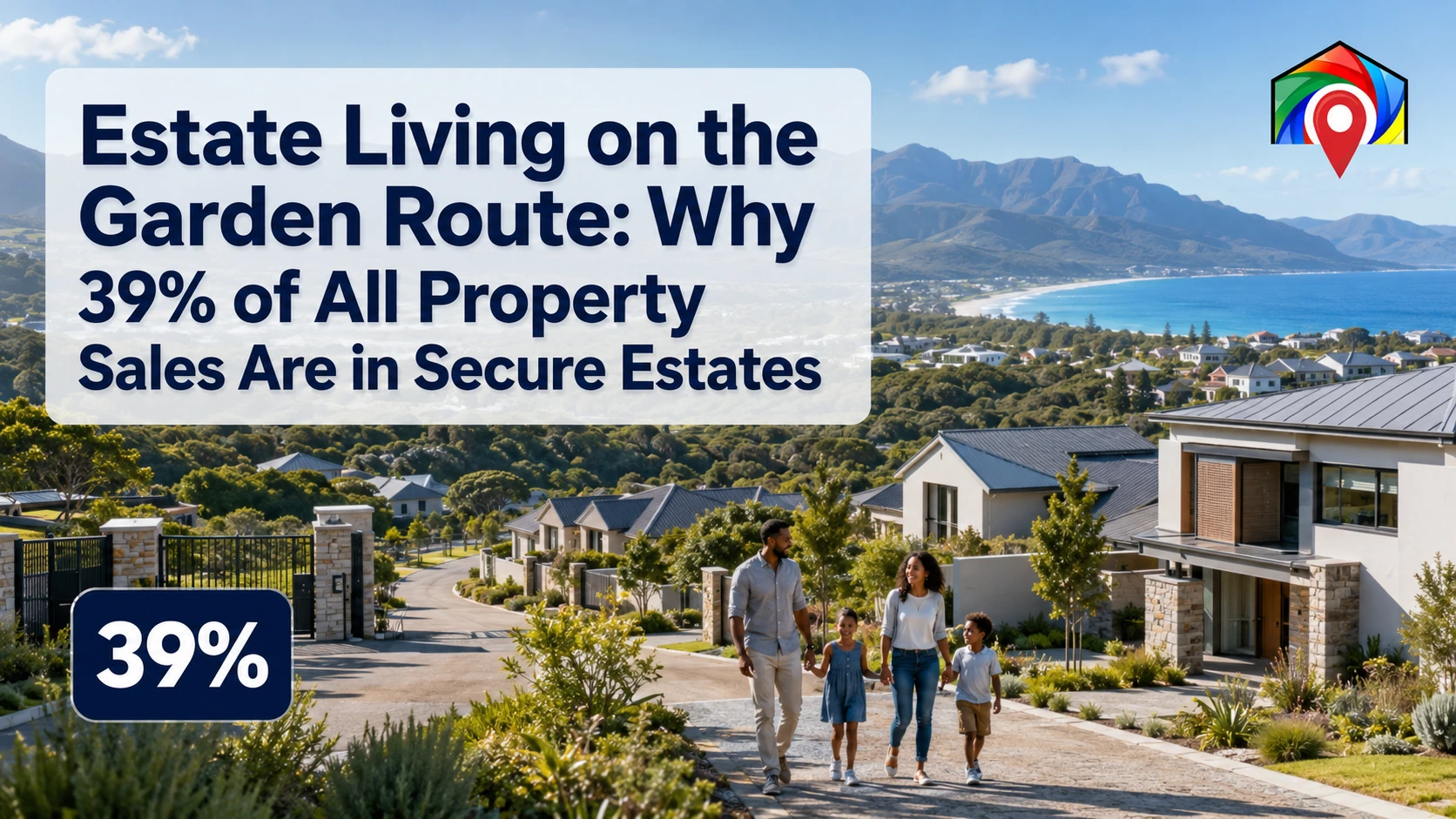
Secure residential estates are becoming central to the Garden Route property market as semigrating families, retirees and investors prioritise security, lifestyle facilities and professionally managed surroundings.
From golf estates in George and Mossel Bay to waterfront communities in Knysna and luxury coastal developments in Plettenberg Bay, estate living now represents a significant part of the region’s residential demand.
However, the headline figure requires an important clarification.
The reported 39% figure relates specifically to property transfers in Plettenberg Bay’s market, where estates account for a substantial share of high-value activity. It should not be interpreted as meaning that exactly 39% of every property sale across the entire Garden Route takes place in an estate. Nevertheless, the figure highlights how influential secure estates have become in one of the region’s most expensive and active coastal markets.
Across George, Mossel Bay, Knysna, Plettenberg Bay and surrounding towns, demand for estate properties is being supported by semigration, limited stock in desirable locations and buyers seeking homes that combine security with everyday lifestyle benefits.
Why Is Estate Living Growing on the Garden Route?
The Garden Route was once associated primarily with holiday homes, retirement properties and seasonal tourism.
It has since developed into a permanent residential destination for:
- Families relocating from major cities
- Remote and hybrid workers
- Retirees
- Professionals
- Property investors
- Returning South Africans
- Holiday-home purchasers
- Buyers seeking a second residence
- High-net-worth lifestyle purchasers
As more households relocate permanently, they are not simply searching for a coastal view. They want homes that support daily family life, remote work, retirement and long-term investment.
Secure estates frequently meet these needs by combining residential property with controlled access, communal facilities and managed surroundings.
What Does the 39% Estate-Sales Figure Really Mean?
The 39% statistic has been associated with Plettenberg Bay, one of the Garden Route’s premium residential markets.
Market reporting published in 2026 stated that estates accounted for approximately 39% of property transfers in Plettenberg Bay, reflecting strong demand for security, lifestyle features and rental potential. The same report noted that more than 20% of transactions exceeded R5 million and about 7% exceeded R10 million, demonstrating the strength of the town’s upper-end market.
This is significant because Plettenberg Bay attracts affluent buyers who often favour:
- Controlled estate access
- Ocean or mountain views
- Modern architecture
- Golf and leisure facilities
- Professionally maintained surroundings
- Holiday-letting potential
- Lock-up-and-go convenience
- Privacy
- Long-term investment appeal
The figure does not prove that 39% of sales in George, Knysna, Mossel Bay, Wilderness and every surrounding town are also estate transactions.
Estate-market activity differs by location.
George may have substantial demand for golf and family estates, while Mossel Bay attracts buyers to coastal, wildlife and retirement developments. Knysna has established waterfront, golf and country estates, whereas Plettenberg Bay contains a strong concentration of luxury lifestyle developments.
The broader message is that secure estates have moved from being a specialist segment to becoming a major part of Garden Route residential demand.
Why Are Buyers Choosing Secure Estates?
1. Security remains a major priority
Security is one of the strongest motivations behind estate living in South Africa.
Controlled entrances, access systems, boundary security and on-site monitoring can offer buyers a greater sense of control than they may experience in an open neighbourhood.
Features vary between developments but may include:
- Manned entrance gates
- Biometric or digital access
- Perimeter fencing
- CCTV monitoring
- Security patrols
- Visitor-management systems
- Controlled contractor access
- Emergency-response procedures
No estate can guarantee complete safety. Buyers should investigate the actual security measures, incident history and management standards rather than relying only on marketing claims.
Nevertheless, a well-managed security environment can be particularly attractive to semigrating families, retirees and buyers who travel frequently.
2. Lifestyle facilities are included in the residential environment
Many Garden Route estates are designed around recreation and outdoor living.
Facilities may include:
- Golf courses
- Walking and cycling trails
- Clubhouses
- Swimming pools
- Tennis or padel courts
- Children’s play areas
- Gyms
- Restaurants
- Nature reserves
- Beach or lagoon access
- Community centres
- Retirement and healthcare facilities
These features can help an estate offer more than a house. Buyers are purchasing access to a managed lifestyle.
For semigrants leaving congested metropolitan areas, the ability to walk, cycle, play golf or access nature within the estate can be a major attraction.
3. Buyers value predictable surroundings
Estate rules can regulate property appearance, building work, noise, parking and the use of common spaces.
Some buyers appreciate these controls because they help preserve a consistent environment.
Architectural guidelines may reduce the risk of neighbouring properties being developed in ways that negatively affect views or street appeal. Maintenance standards may also help common areas remain attractive.
However, the same rules can feel restrictive to purchasers who want complete freedom over their property.
A buyer should read the estate’s governance documents before signing an offer.
4. Estate homes can suit lock-up-and-go living
Garden Route buyers often travel between provinces, own more than one property or spend part of the year elsewhere.
Secure apartments, townhouses and compact estate homes may offer greater convenience than large freestanding properties in open suburbs.
Lock-up-and-go buyers often prioritise:
- Managed security
- Lower garden maintenance
- Shared facilities
- Estate maintenance standards
- Remote access control
- Proximity to airports and major routes
- Easy short-term vacancy management
This can appeal to retirees, executives, holiday-home owners and investors.
5. Estate properties can attract tenants
Tenants relocating to the Garden Route may prefer to rent before buying.
A secure estate can offer an easier transition for households unfamiliar with the area. Families may value proximity to schools, outdoor facilities and controlled access, while professionals may look for fibre internet and home-office space.
Potential rental demand may come from:
- Semigrating families
- Corporate tenants
- Remote workers
- Retirees
- Seasonal visitors
- Medical professionals
- Executives
- Households building a new home
- Buyers waiting for a suitable property
Rental demand can support investment value, but owners must confirm whether the estate allows long-term or short-term letting.
How Semigration Is Driving Estate Demand
Semigration has reshaped the Garden Route property market.
Households relocating from Gauteng, KwaZulu-Natal and larger Western Cape centres may have different expectations from traditional holiday buyers.
Permanent residents generally require:
- Good schools
- Reliable internet
- Healthcare access
- Shopping facilities
- Secure parking
- Home offices
- Outdoor family space
- Backup utilities
- Community facilities
- Long-term residential stability
The Garden Route’s established towns increasingly offer this combination.
Property reporting has shown that families and professionals now represent a larger part of the region’s buyer market, moving it beyond its traditional holiday and retirement identity. In Knysna, almost 30% of properties were reportedly valued above R5 million, with premium values concentrated in estates and exclusive areas such as Thesen Islands, Pezula, Simola, Eastford and Belvidere.
Estate living can make semigration feel less uncertain by providing an organised residential environment and a built-in sense of community.
Why Estate Demand Is Strong in Plettenberg Bay
Plettenberg Bay occupies the luxury end of the Garden Route market.
Its appeal comes from:
- Beaches
- Ocean views
- Limited premium coastal land
- Established luxury developments
- High-end holiday demand
- Lifestyle facilities
- Secure residential options
- Strong interest from affluent semigrants
- International and returning South African buyers
The town’s estate market includes a combination of golf developments, coastal communities, residential estates and sectional-title schemes.
The reported 39% share of transfers demonstrates how important this segment has become in Plettenberg Bay.
What Plettenberg Bay estate buyers may prioritise
- Ocean, lagoon or mountain views
- Security
- Beach access
- Modern finishes
- Holiday-letting potential
- Low-maintenance landscaping
- Backup electricity
- Fibre internet
- Entertainment areas
- Privacy
- Golf or leisure facilities
Luxury estate properties can command strong prices, but they also have a narrower buyer market. Properties with excessive levies, outdated finishes or unrealistic prices may take longer to sell.
Estate Living in George
George has become one of the Garden Route’s strongest permanent-residential centres.
Unlike smaller coastal towns that remain heavily dependent on tourism, George has:
- An airport
- Schools
- Hospitals
- Shopping centres
- Government services
- Professional businesses
- Industrial activity
- Sports facilities
- Retirement communities
- Golf and lifestyle estates
This makes it especially attractive to families and working professionals.
Why George estates appeal to buyers
George estates may provide:
- Access to schools and employment
- Mountain and countryside surroundings
- Golf facilities
- Family homes
- Retirement options
- Controlled access
- New residential developments
- Proximity to George Airport
- Access to nearby beaches
- Strong long-term rental demand
Estate properties in George can serve both the upper market and more accessible family segments, depending on the development.
Popular property types include:
- Freestanding family homes
- Golf-estate residences
- Townhouses
- Retirement units
- Apartments
- Vacant residential stands
- New-build houses
Estate Living in Mossel Bay
Mossel Bay has evolved from a seasonal holiday destination into a permanent residential and semigration market.
The area offers a variety of secure developments, including:
- Coastal estates
- Golf estates
- Wildlife-oriented developments
- Retirement villages
- Gated family communities
- Sectional-title complexes
- New residential projects
Mossel Bay’s appeal is supported by coastal living, access to schools and healthcare, municipal infrastructure and its position within the wider Garden Route.
What Mossel Bay estate buyers may seek
- Sea views
- Secure access
- Retirement-friendly designs
- Golf or leisure facilities
- Modern family homes
- Access to beaches
- Low-maintenance properties
- Space for remote work
- New-build opportunities
- More accessible prices than some premium Garden Route towns
Estate levies and building restrictions vary substantially. A large luxury golf estate may operate very differently from a small gated townhouse development.
Estate Living in Knysna
Knysna has one of the Garden Route’s most established lifestyle-property markets.
Its lagoon, forests and surrounding hills create opportunities for:
- Waterfront estates
- Golf estates
- Country developments
- Nature-oriented communities
- Secure residential neighbourhoods
- Luxury sectional-title properties
Property24 reporting identifies Thesen Islands, Pezula, Simola, Eastford Country Estate and Belvidere Estate among the locations associated with premium Knysna property values.
Why Knysna estates attract buyers
- Lagoon and mountain views
- Waterfront access
- Golf facilities
- Controlled residential environments
- Established luxury homes
- Holiday and permanent-living potential
- Proximity to town
- Strong lifestyle identity
Environmental risk should form part of any Knysna purchase decision.
Depending on the location, buyers may need to investigate:
- Fire exposure
- Drainage
- Slope stability
- Vegetation management
- Insurance costs
- Water availability
- Coastal maintenance
- Evacuation routes
Estate Living in Sedgefield and Wilderness
Sedgefield and Wilderness have smaller property markets than George or Mossel Bay, but they appeal to buyers seeking lower-density living and close access to nature.
Secure developments in these areas may attract:
- Retirees
- Remote workers
- Nature-focused buyers
- Holiday-home purchasers
- Small families
- Investors
Because available property stock can be limited, well-positioned estate homes may attract strong demand when they enter the market.
Buyers should consider whether the location provides practical access to:
- Schools
- Healthcare
- Shopping
- Airports
- Employment centres
- Emergency services
- Reliable internet
- Municipal infrastructure
What Types of Estates Are Available?
Not every secure estate offers the same lifestyle.
Golf estates
Golf estates may offer:
- Golf-course access
- Clubhouses
- Restaurants
- Walking routes
- Landscaped surroundings
- Premium views
- Controlled architecture
Buyers should investigate golf membership requirements, additional fees and whether non-golfing residents receive value from the facilities.
Coastal estates
Coastal developments may provide:
- Ocean views
- Beach access
- Nature trails
- Holiday-letting potential
- Luxury homes
- Lifestyle facilities
Potential disadvantages include salt damage, wind exposure, erosion risk and higher maintenance costs.
Wildlife and nature estates
Nature-focused estates can offer:
- Larger stands
- Indigenous landscapes
- Wildlife
- Walking trails
- Lower-density living
- Greater privacy
Rules may limit fencing, pets, landscaping and construction.
Family lifestyle estates
These developments often focus on:
- Schools or nearby education
- Playgrounds
- Parks
- Cycling routes
- Sports facilities
- Community spaces
- Practical family homes
They may appeal strongly to semigrating households with children.
Retirement estates
Retirement developments may provide:
- Security
- Single-level homes
- Healthcare services
- Assisted living
- Frail-care facilities
- Social activities
- Maintenance support
- Accessible designs
Purchasers should understand the ownership model, age restrictions, medical services and resale conditions.
Sectional-title complexes
Sectional-title developments include apartments and townhouses in which owners hold individual sections while sharing ownership of common property.
They may offer lower purchase prices and reduced maintenance responsibility compared with freestanding estate homes.
Buyers should inspect the body corporate’s financial position and maintenance plan.
What Are the Financial Benefits of Estate Property?
Estate property can provide several potential advantages.
Strong buyer demand
Security and lifestyle facilities may make estate homes attractive to a wider buyer market.
Resale appeal
Well-managed estates with good locations and stable finances may maintain strong resale demand.
Rental opportunities
Families, professionals and retirees may pay a premium for secure, well-maintained environments.
Managed common areas
The cost of maintaining roads, landscaping, entrances and shared facilities is distributed among owners through levies.
Greater environmental consistency
Architectural and maintenance standards can support the estate’s visual appeal.
These benefits are not guaranteed. Poor governance, excessive levies or neglected infrastructure can reduce an estate’s attractiveness.
What Are the Costs of Estate Living?
The purchase price is only one part of the cost.
Estate owners may be responsible for:
- Homeowners’ association levies
- Body-corporate levies
- Special levies
- Municipal rates
- Utility charges
- Insurance
- Security contributions
- Maintenance
- Golf or club membership
- Landscaping
- Compliance costs
- Transfer and bond-registration expenses
Levies may increase over time as wages, security, insurance and maintenance costs rise.
Buyers should request a complete schedule of charges before submitting an offer.
What Should Buyers Check Before Purchasing in an Estate?
Estate finances
Request:
- Recent audited financial statements
- Current levy schedule
- Approved annual budget
- Details of outstanding owner levies
- Reserve-fund information
- Planned capital projects
- Special levies
- Insurance information
A visually attractive estate can still have financial problems.
Governance and management
Investigate:
- Who manages the estate
- How trustees or directors are elected
- Whether meetings are held regularly
- Whether disputes are common
- How rules are enforced
- Whether governance documents are current
- How complaints are managed
Conduct rules
Review restrictions relating to:
- Pets
- Parking
- Visitors
- Noise
- Renovations
- Solar panels
- Water tanks
- Exterior paint
- Home businesses
- Holiday rentals
- Long-term tenants
- Landscaping
- Vehicles
- Children’s activities
Do not assume that a planned lifestyle will be permitted.
Building rules
Vacant-land buyers should confirm:
- Building deadlines
- Minimum house sizes
- Architectural requirements
- Approved materials
- Contractor rules
- Penalties for late construction
- Plan-approval fees
- Landscaping requirements
- Environmental restrictions
Security
Ask about:
- Access systems
- Patrols
- CCTV
- Incident history
- Emergency response
- Perimeter maintenance
- Visitor procedures
- Security costs
- Power backup for security systems
Infrastructure
Confirm responsibility for:
- Roads
- Street lighting
- Water
- Sewerage
- Stormwater
- Refuse collection
- Electricity
- Fibre internet
- Common facilities
Some services may be maintained privately, while others remain municipal responsibilities.
Can Estate Levies Affect Property Value?
Yes.
Levies can support property values when they are used efficiently to maintain security, roads, landscaping and shared facilities.
However, excessive or rapidly increasing levies can reduce affordability and discourage future purchasers.
A buyer comparing two similar homes may prefer the property with:
- Lower monthly levies
- Better facilities
- Stronger financial reserves
- Transparent governance
- Fewer special levies
- Better-maintained infrastructure
A low levy is not automatically a positive sign. It may indicate that an estate is underfunding maintenance and could require substantial special contributions later.
Are Estate Properties Good Investments?
Estate property can be an attractive investment when the development offers genuine buyer and tenant demand.
The investment case may be strongest when an estate has:
- A desirable location
- Effective security
- Sound financial management
- Reasonable levies
- Limited competing stock
- High-quality infrastructure
- Access to schools and amenities
- Reliable rental demand
- Clear governance
- Strong resale history
Investors should calculate the net return after deducting:
- Levies
- Rates
- Insurance
- Maintenance
- Management fees
- Vacancy periods
- Finance costs
- Tax
- Furnishing
- Special levies
A property with an impressive gross rental may produce a much weaker net return after costs.
What Are the Risks of Buying in an Estate?
High or rising levies
Facilities and extensive security can be expensive to operate.
Special levies
Major repairs or underfunded reserves may lead to additional charges.
Restrictive rules
Owners may be prevented from making preferred alterations or using the property for short-term accommodation.
Poor governance
Weak management can lead to disputes, neglected maintenance and financial instability.
Oversupply
Large developments with many similar homes may create competition when owners sell or rent.
Construction disruption
Buyers in developing estates may live near building activity for several years.
Developer risk
Incomplete infrastructure or delayed facilities can affect early purchasers.
Environmental exposure
Coastal estates may face wind, salt, fire, flood or erosion risks.
Limited affordability
Luxury estate homes may take longer to sell because fewer buyers can qualify.
Estate Property Versus an Open Suburb
Neither option is automatically better.
An estate may offer:
- Controlled access
- Managed common areas
- Shared facilities
- Architectural consistency
- Community activities
- Lock-up-and-go convenience
An open suburb may offer:
- Fewer conduct restrictions
- No homeowners’ association levy
- Greater renovation freedom
- Larger or more individual properties
- Less formal governance
- Potentially lower monthly costs
The correct choice depends on the buyer’s lifestyle, budget and tolerance for rules.
What Does Estate Demand Mean for Garden Route Sellers?
Owners of well-positioned estate properties may benefit from continued demand from semigrants, retirees and investors.
The properties most likely to attract attention may include:
- Modern family homes
- Low-maintenance properties
- Houses with home offices
- Homes with backup power and water
- Properties near estate facilities
- Units with manageable levies
- Homes with views
- Renovated properties
- Lock-up-and-go residences
- Pet-friendly homes where permitted
Sellers should provide potential buyers with complete estate information, including:
- Current levies
- Estate rules
- Homeowners’ association documents
- Approved building plans
- Special-levy information
- Rental restrictions
- Security details
- Compliance certificates
Uncertainty about estate costs or rules can delay a transaction.
How Should Estate Homes Be Priced?
Estate properties should be compared with recent sales within the same development wherever possible.
A home outside the estate may not be a reliable comparison because estate facilities, security and levies influence value.
Pricing should account for:
- Position within the estate
- Views
- Stand and floor size
- Property condition
- Privacy
- Proximity to entrances or facilities
- Levies
- Renovations
- Additional accommodation
- Parking
- Age of the home
- Completed registered sales
Sellers should not assume that every property in a popular estate deserves the same price per square metre.
Can Secure Estates Continue Taking a Larger Share of Sales?
Estate living is likely to remain an important segment of the Garden Route market.
Demand is supported by:
- Continued semigration
- Security priorities
- Retirement migration
- Remote working
- Family relocation
- Lifestyle-focused buying
- New estate development
- Investment demand
- Limited stock in established estates
However, the sector’s future performance will depend on affordability.
Rising property prices and levies may push some purchasers toward townhouses, smaller developments or open suburbs.
Successful estates will need to balance security and amenities with sustainable ownership costs.
Frequently Asked Questions
Are 39% of all Garden Route property sales in estates?
The available 39% figure refers specifically to transfers in Plettenberg Bay, not every property transaction across the entire Garden Route. It nevertheless shows the strength of estate demand within one of the region’s leading luxury markets.
Why are secure estates popular on the Garden Route?
Buyers are attracted by controlled access, lifestyle facilities, maintained common areas, architectural standards and the convenience of a managed residential environment.
Which Garden Route towns offer estate property?
Estate homes are available throughout George, Mossel Bay, Knysna, Plettenberg Bay and surrounding coastal towns.
Are estate properties more expensive?
They may command a premium because of security, facilities and location. Owners must also budget for levies and possible special contributions.
Can owners rent out an estate property?
This depends on the development’s rules. Some allow long-term and short-term rentals, while others restrict or prohibit holiday letting.
Are estate levies worth paying?
Levies can provide value when they fund effective security, infrastructure and facilities. Buyers should assess whether the costs are reasonable and whether the estate is financially well managed.
Is a golf estate suitable for a buyer who does not play golf?
It can be, provided the buyer values the security, environment and other facilities. The purchaser should determine whether golf-related costs form part of the compulsory levy structure.
Is estate property a good investment?
It can be when the development has strong demand, sound finances and reasonable ownership costs. The individual purchase price and net rental return remain critical.
Final Thoughts
Estate living has become one of the defining features of the Garden Route property market.
The reported 39% share of transfers in Plettenberg Bay demonstrates how strongly buyers in premium coastal markets favour managed residential communities. It does not represent the exact percentage of estate sales throughout the entire Garden Route, but it reflects a broader regional shift toward security, convenience and lifestyle-led property choices.
George offers established golf, retirement and family estates supported by permanent infrastructure and employment.
Mossel Bay combines coastal, golf and lifestyle developments with a growing semigration market.
Knysna provides some of the region’s best-known waterfront, golf and country-estate environments, with premium values concentrated in developments such as Thesen Islands, Pezula and Simola.
Plettenberg Bay remains the region’s luxury leader, where secure estates form a significant part of high-value sales.
For buyers, estate living can offer security, facilities and an organised residential environment. The advantages must be weighed against levies, rules, governance and long-term affordability.
The estate’s reputation is important, but the quality of its management and finances may matter even more.
Explore Garden Route Estate Property on ZAP HUB
Discover houses, townhouses, apartments, retirement properties, golf-estate homes and secure lifestyle properties across the Garden Route on ZAP HUB.
Explore available estate properties in George, Mossel Bay, Knysna, Plettenberg Bay and surrounding Western Cape locations.
Compare listings and connect directly with property professionals who understand the local estate market.
Start exploring secure Garden Route properties on ZAP HUB today.
This article provides general property-market information and does not constitute financial, legal, tax or investment advice. The 39% figure referenced in this article relates to reported Plettenberg Bay property transfers and should not be applied uniformly to the entire Garden Route. Estate conditions, levies, rules and property values differ between developments.