
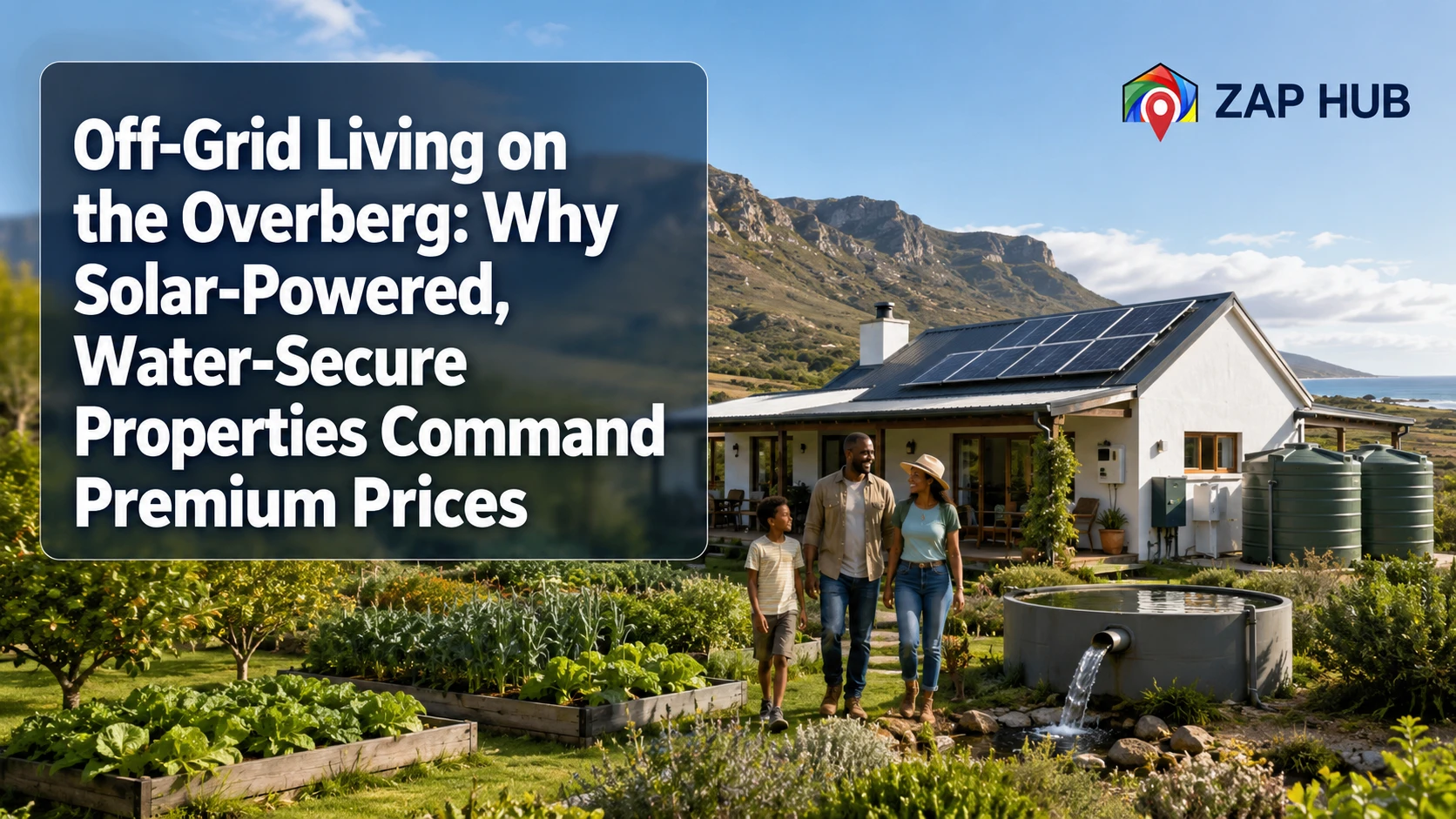
In the Overberg, property value is increasingly influenced not only by location, views and floor area, but also by whether a home can continue functioning when conventional services are interrupted.
Buyers exploring Hermanus, Stanford, Gansbaai, Greyton, Caledon, Bredasdorp, Napier, Swellendam and the region’s rural smallholdings are paying greater attention to properties equipped with:
- Solar photovoltaic panels
- Battery storage
- Hybrid or off-grid inverters
- Backup generators
- Boreholes
- Rainwater-harvesting systems
- Large water-storage tanks
- Filtration and purification equipment
- Energy-efficient appliances
- Independent wastewater systems
- Productive gardens and agricultural infrastructure
These features can make a property more resilient, reduce dependence on external services and support remote working, tourism, farming or permanent rural living.
However, the headline requires an important qualification.
There is no reliable rule stating that every Overberg home with solar panels or a borehole automatically commands a fixed percentage premium. The value added depends on the system’s capacity, condition, compliance, documentation and suitability for the property.
A properly engineered solar-and-battery installation combined with a tested, legally compliant water supply can strengthen marketability and justify a higher asking price. An undocumented installation, ageing battery bank or unreliable borehole may provide little additional value and could create risk for the buyer.
The premium is therefore not paid merely for equipment. It is paid for proven resilience.
Why Off-Grid Living Appeals to Overberg Buyers
The Overberg includes coastal towns, agricultural districts, mountain villages and rural communities spread across a large part of the Western Cape.
The Overberg District Municipality governs four local municipalities:
- Overstrand
- Cape Agulhas
- Swellendam
- Theewaterskloof
The district includes major property markets such as Hermanus, Gansbaai, Bredasdorp, Swellendam, Caledon, Grabouw and surrounding rural areas.
The region attracts several buyer groups:
- Families relocating from metropolitan areas
- Retirees
- Remote and hybrid workers
- Farmers
- Tourism operators
- Guesthouse owners
- Lifestyle-smallholding purchasers
- Eco-conscious buyers
- Holiday-home buyers
- Investors seeking distinctive rural accommodation
For many of these buyers, uninterrupted access to electricity and water is not simply a convenience.
A remote worker needs reliable electricity and internet.
A guesthouse owner cannot easily accommodate visitors without hot water, lighting and refrigeration.
A small farmer may require power for pumps, irrigation and refrigeration.
A household on a rural property may be located too far from immediate municipal or technical support to tolerate prolonged service interruptions.
This makes self-sufficiency more valuable in the Overberg than it may be in a conventional urban apartment.
What Does “Off-Grid” Really Mean?
The term “off-grid” is often used loosely in property advertising.
A property may be described as off-grid when it is actually only partially independent.
Fully off-grid
A genuinely off-grid property normally operates without relying on the conventional electricity network for its daily power supply.
It may use:
- Solar panels
- Battery storage
- Inverters
- A backup generator
- Gas appliances
- Solar water heating
- Independent water systems
- Septic tanks or alternative sanitation
Grid-connected with backup power
Many Overberg homes remain connected to the electricity network but have solar and batteries that reduce grid consumption and provide power during interruptions.
This is more accurately described as:
- Solar-assisted
- Hybrid
- Grid-tied with battery backup
- Energy resilient
Water-secure rather than water-independent
A home connected to municipal water may also have:
- Rainwater tanks
- A borehole
- A well point
- Dam storage
- Filtration
- Greywater reuse
Such a property is water-secure, but not necessarily completely independent of municipal water.
Accurate terminology matters because buyers may make financial decisions based on the level of independence being advertised.
Why Buyers May Pay More for Energy Resilience
A high-quality solar system can provide several benefits.
Reduced exposure to interruptions
Battery storage can keep essential systems functioning during electricity failures.
Depending on its capacity, the system may support:
- Lighting
- Refrigeration
- Internet
- Security
- Gate motors
- Borehole pumps
- Computers
- Television
- Selected kitchen appliances
- Heating and cooling equipment
Lower electricity consumption
Solar generation may reduce the amount of electricity purchased from the grid.
Actual savings depend on:
- Household consumption
- System size
- Battery use
- Solar orientation
- Weather
- Electricity tariffs
- Equipment efficiency
- Whether surplus generation can be exported
- The household’s daytime usage
Improved remote-work suitability
A home with dependable electricity and internet can appeal to professionals relocating from Cape Town, Johannesburg or other major cities.
Remote workers often prioritise:
- Backup power
- Fibre or reliable wireless internet
- A dedicated office
- Stable cellphone coverage
- Security
- Access to nearby services
Greater tourism reliability
Guesthouses, holiday homes and rural retreats may benefit from uninterrupted:
- Lighting
- Wi-Fi
- Hot water
- Refrigeration
- Security
- Payment systems
- Pool and water pumps
Guests may be less tolerant of service failures than permanent residents, making resilience an operating advantage.
Reduced installation inconvenience
A buyer may prefer to pay more for a completed and documented system rather than arrange:
- Technical assessments
- Installer appointments
- Equipment sourcing
- Registration
- Electrical upgrades
- Roof work
- Municipal or Eskom applications
This convenience can support a premium when the installation is compliant and appropriately designed.
Does Solar Automatically Increase a Property’s Value?
Not necessarily.
A property’s solar installation adds meaningful value when it is:
- Professionally designed
- Correctly sized
- Properly installed
- Legally compliant
- Fully documented
- In good working condition
- Supported by warranties
- Suitable for the home’s usage
- Compatible with future expansion
- Insurable
South African property and energy commentary increasingly associates solar-plus-storage with stronger marketability and a better value proposition than comparable grid-dependent homes. However, the added value remains property-specific rather than a guaranteed national percentage.
A poorly executed installation can reduce buyer confidence.
Potential problems include:
- Undersized batteries
- Incorrect wiring
- Unapproved equipment
- Roof leaks
- Insufficient surge protection
- Ageing batteries
- Unsupported inverter brands
- Missing electrical certificates
- Improper grid connection
- No installation warranty
- Inability to power essential pumps or appliances
The buyer should assess the solar system as infrastructure—not as a decorative feature.
Why Solar Compliance Is Important
Residential solar installations connected to a network must meet applicable technical and registration requirements.
Eskom states that small-scale embedded generation customers need to submit compliance documentation as part of the registration process. Its current simplified requirements include a valid Certificate of Compliance, an inverter test certificate and an installation test report. Eskom has extended eligible registration-related fee relief until 30 September 2026.
Eskom’s registration process generally involves:
- Submitting customer and system details
- Uploading compliance documents
- Receiving approval and any required metering arrangements
The exact process may differ where the property is supplied by a municipality rather than Eskom.
Before purchasing, buyers should request:
- Electrical Certificate of Compliance
- Solar-system design
- Installer details
- Inverter test documentation
- Registration or approval records
- Panel specifications
- Battery specifications
- Warranty documents
- Maintenance records
- Monitoring-system access
- Proof of ownership or finance settlement
A leased or financed solar system may not automatically transfer with the property. The sale agreement should clearly identify who owns the equipment and whether any outstanding contract exists.
What Makes a Solar System Valuable?
A larger system is not always a better system.
The most valuable installation is one that matches the property’s requirements.
Solar panels
Buyers should check:
- Number of panels
- Total generating capacity
- Installation date
- Manufacturer
- Warranty
- Roof orientation
- Shading
- Mounting quality
- Roof condition
Inverter
Important considerations include:
- Rated capacity
- Single- or three-phase compatibility
- Hybrid capability
- Approved equipment status
- Manufacturer support
- Expansion potential
- Installation quality
Batteries
Battery value depends on:
- Usable capacity
- Chemistry
- Age
- Cycle count
- Warranty
- Depth of discharge
- Replacement cost
- Brand support
- Operating temperature
A property advertised as having a “10 kWh battery” may provide less usable energy depending on the equipment and settings.
Essential-load configuration
Buyers must establish which circuits remain active during an outage.
The system may power only:
- Lights
- Wi-Fi
- Refrigeration
- Security
It may not support:
- Ovens
- Electric geysers
- Pool pumps
- Air conditioning
- Borehole pumps
- Underfloor heating
The phrase “fully solar powered” should be tested against actual performance and historical consumption.
Existing Overberg Listings Show the Resilience Trend
Current and recent Overberg listings increasingly highlight off-grid or hybrid infrastructure as a selling feature.
A premium home in Romansbaai Estate near Gansbaai was marketed with:
- 27 solar panels
- Four 5 kW batteries
- Two 12 kW inverters
- Borehole-supplied garden water
- A 5,000-litre storage tank
The listing described the property as capable of operating through a self-sufficient solar system, illustrating the level of infrastructure now included in selected premium coastal homes.
A substantial property near Pearly Beach has also been marketed with a completely off-grid owner’s residence and full solar system, alongside tourism and development potential.
In the Swellendam rural market, properties are being promoted for solar energy, eco-tourism and off-grid accommodation concepts.
These listings do not prove that every solar installation produces a specific price premium. They do demonstrate that energy independence has become a prominent marketing and buyer-positioning feature in the Overberg.
Why Water Security Matters Just as Much as Solar
Electricity resilience receives more attention, but water can be the more critical issue on rural and lifestyle properties.
Water is required for:
- Drinking
- Cooking
- Sanitation
- Gardens
- Livestock
- Irrigation
- Guest accommodation
- Pools
- Fire protection
- Cleaning
- Small-scale agricultural activity
A solar-powered home without a reliable water supply is not truly resilient.
What Is a Water-Secure Property?
A water-secure property may have several complementary sources and systems.
These can include:
- Municipal water
- Registered boreholes
- Wells
- Rainwater tanks
- Dams
- Springs
- Agricultural water allocations
- Filtration
- Purification
- Pressure pumps
- Greywater reuse
- Fire-water storage
- Irrigation systems
The strongest properties normally avoid dependence on a single source.
For example, a home may use:
- Municipal water for drinking
- Rainwater for toilets and cleaning
- Borehole water for gardens
- A dedicated tank for fire emergencies
This layered approach can improve resilience.
A Borehole Is Not Automatically Reliable
A borehole can be valuable, but buyers should not assume that water will always be sufficient or safe.
The borehole must be assessed for:
- Depth
- Yield
- Recovery rate
- Seasonal performance
- Pump condition
- Water quality
- Salinity
- Mineral content
- Registration
- Permitted use
- Storage capacity
- Electricity requirements
- Maintenance history
A borehole producing strongly during a wet winter may perform differently after a dry summer.
Water quality may also vary over time.
Water Quality and Legal Responsibility
Overstrand Municipality provides a formal process for registering boreholes and well points.
Its Water Supply and Sanitation Services By-law states that an owner using borehole or well-point water for human consumption must ensure that the water complies with the applicable SANS 241 quality standards. The municipality is not liable for health incidents arising from the use of private borehole or well-point water.
This means buyers should request recent laboratory testing before treating borehole water as potable.
Tests may examine:
- Bacteria
- Nitrates
- Salinity
- Iron
- Manganese
- pH
- Dissolved solids
- Other location-specific contaminants
Water described as “clear” or “good tasting” is not necessarily safe to drink.
Why Rainwater Storage Adds Value
Rainwater harvesting is particularly useful when combined with municipal or borehole water.
A rainwater system may include:
- Gutters
- Leaf filters
- First-flush diverters
- Storage tanks
- Pumps
- Filtration
- Overflow management
- Irrigation connections
- Household supply connections
Its usefulness depends on:
- Roof area
- Local rainfall
- Tank capacity
- Household consumption
- Intended use
- Filtration
- Seasonal storage strategy
Small decorative tanks may provide limited resilience.
A meaningful water-security system normally requires sufficient storage and a clear plan for how the water will be used.
Municipal Water Still Requires Responsible Use
Overstrand Municipality currently reports no general water restrictions, but it maintains a permanent prohibition on garden irrigation between 09:00 and 17:00 to reduce evaporation and continues to encourage careful use of water.
This illustrates an important distinction:
Water security does not mean unlimited water consumption.
Even properties with boreholes, tanks or dams should use water responsibly because groundwater and stored supplies can be depleted.
Which Overberg Areas Attract Off-Grid Buyers?
Hermanus and Surrounding Coastal Suburbs
Hermanus attracts permanent residents, retirees, holiday-home owners and international buyers.
Off-grid or resilient homes may be found in and around:
- Hermanus Central
- Eastcliff
- Westcliff
- Fernkloof
- Voëlklip
- Onrus
- Vermont
- Sandbaai
- Chanteclair
- Hemel-en-Aarde
- Fisherhaven
In higher-priced coastal suburbs, buyers may expect premium homes to include:
- Solar and battery systems
- Water storage
- Security backup
- Energy-efficient glazing
- Pool-heating systems
- Remote monitoring
- Climate-control resilience
A high asking price does not guarantee that these systems are included or compliant.
Stanford
Stanford attracts lifestyle buyers, retirees, artists, remote workers and smallholding purchasers.
Properties may include:
- Village houses
- Riverfront homes
- Small farms
- Equestrian properties
- Guesthouses
- Rural retreats
Water and energy independence can be particularly valuable on properties outside the compact village centre.
Buyers should investigate:
- Flood exposure
- Borehole performance
- River proximity
- Septic systems
- Internet connectivity
- Road access
- Solar compliance
Gansbaai and the Greater Gansbaai Coast
The wider Gansbaai market includes:
- Gansbaai Central
- De Kelders
- Kleinbaai
- Franskraal
- Perlemoenbaai
- Romansbaai
- Pearly Beach
- Rural properties
Solar and water systems appeal to:
- Permanent residents
- Guesthouse operators
- Holiday-home buyers
- Retirees
- Eco-tourism investors
- Lifestyle-farm purchasers
Coastal installations require additional maintenance because of salt, wind and corrosion.
Greyton and Genadendal
Greyton is known for its village atmosphere, mountain setting and access to nature.
Properties with solar, tanks, productive gardens and backup systems may appeal to buyers seeking:
- Village living
- Remote work
- Retirement
- Weekend use
- Sustainable lifestyles
- Mountain access
Buyers should check whether water sources, pumps and additional structures have been properly approved.
Caledon and Theewaterskloof Rural Areas
Caledon and surrounding agricultural districts provide access to:
- Farms
- Smallholdings
- Town properties
- Agricultural businesses
- Rural tourism
Larger rural properties may require solar for:
- Pumping
- Workshops
- Cold storage
- Staff accommodation
- Irrigation controls
- Security systems
Agricultural energy use can substantially exceed normal household consumption. A residential-scale solar system may not support farming operations.
Bredasdorp, Napier and Cape Agulhas
Bredasdorp provides commercial and administrative services for the southern Overberg, while Napier and the Cape Agulhas area attract rural and coastal lifestyle buyers.
Relevant locations include:
- Bredasdorp
- Bredasdorp Rural
- Napier
- Struisbaai
- Agulhas
- Suiderstrand
- Elim
- Arniston
- Waenhuiskrans
Properties may combine:
- Solar
- Water tanks
- Boreholes
- Guest accommodation
- Agricultural land
- Coastal holiday use
- Remote-working capability
Wind exposure and salt corrosion are particularly important near the coast.
Swellendam and Rural Surroundings
Swellendam appeals to families, retirees, agricultural buyers and tourism operators.
Rural properties may use independent infrastructure because of:
- Distance from town
- Agricultural operations
- Guest accommodation
- Pumping requirements
- Large gardens
- Livestock
- Workshops
Recent Swellendam rural marketing has explicitly promoted renewable-energy and off-grid development potential, demonstrating the growing importance of resilience in rural property positioning.
Why These Properties Can Command Premium Prices
A premium may arise from several forms of value.
Replacement value
A buyer avoids the cost of installing comparable equipment after transfer.
This can include:
- Solar panels
- Batteries
- Inverters
- Electrical redesign
- Borehole drilling
- Pumps
- Water tanks
- Filtration
- Backup generators
- Monitoring systems
However, replacement cost does not equal market value.
A seller who spent R600,000 on infrastructure cannot assume that the property’s value increased by exactly R600,000.
Reduced operational disruption
A resilient property can remain functional during service interruptions.
This is particularly valuable for:
- Businesses
- Guesthouses
- Remote workers
- Farms
- Security-sensitive households
- Medical or refrigeration requirements
Lower future upgrade burden
Buyers may pay more for a completed system because installation can be technically and administratively complex.
Scarcity
Not every comparable Overberg property has a comprehensive, compliant energy-and-water solution.
A well-equipped home can therefore stand out within its local market.
Emotional confidence
Buyers may value the feeling that the property can provide:
- Security
- Continuity
- Independence
- Predictable living conditions
- Protection from future utility increases
Emotional value can influence an offer, but professional valuation will still consider comparable sales and broader market conditions.
What Can Reduce or Eliminate the Premium?
Old battery technology
Batteries approaching the end of their useful life may create an immediate replacement expense.
Missing documentation
A system without certificates, warranties or technical records may be treated as a liability.
Unregistered grid connection
The buyer may inherit a compliance problem.
Inadequate system capacity
A small backup system marketed as “off-grid” can disappoint buyers.
Poor roof condition
Panels installed on a roof requiring replacement may have to be removed and reinstalled.
Unreliable borehole
Low yield or poor-quality water reduces usefulness.
Insufficient storage
A borehole or rainwater system without adequate tanks may provide limited resilience.
High maintenance
Complex systems requiring specialist support can discourage some buyers.
Overcapitalisation
Premium equipment in an otherwise weak location may not be fully reflected in the resale price.
Buyer Due-Diligence Checklist for Solar
Request and verify:
- Installation date
- Total panel capacity
- Inverter capacity
- Battery capacity
- Battery age
- Battery cycle information
- Equipment brands
- Warranty status
- Electrical Certificate of Compliance
- Inverter test certificate
- Registration or municipal approval
- Installer credentials
- Monitoring reports
- Maintenance records
- Essential-load schedule
- Generator integration
- Grid-export arrangement
- Insurance acceptance
- Ownership of the equipment
- Outstanding finance or rental agreements
Ask the seller to demonstrate the system operating under battery power.
Buyer Due-Diligence Checklist for Water
Confirm:
- Municipal connection
- Borehole registration
- Borehole depth
- Yield test
- Seasonal performance
- Recent laboratory results
- Pump specifications
- Tank capacities
- Filtration systems
- Water-pressure system
- Rainwater harvesting
- Dam or spring rights
- Irrigation design
- Fire-water storage
- Greywater arrangements
- Water-use authorisations where applicable
- Maintenance records
- Backup power for pumps
- Plumbing separation between potable and non-potable supplies
A functioning borehole is of limited use during an electricity failure when the pump has no backup supply.
Insurance Considerations
Buyers should confirm that the insurer will cover:
- Solar panels
- Inverters
- Batteries
- Pumps
- Borehole equipment
- Water tanks
- Generators
- Lightning damage
- Fire
- Theft
- Storm damage
- Electrical surges
Insurance may depend on:
- Professional installation
- Certificates
- Approved equipment
- Security
- Maintenance
- Disclosure of system value
Coastal homes may also face additional risk from:
- Salt corrosion
- Strong winds
- Water intrusion
- Storms
The replacement cost should be included accurately in the policy.
Off-Grid Does Not Mean Maintenance-Free
Independent infrastructure transfers responsibility from a utility provider to the owner.
Maintenance may include:
- Cleaning panels
- Monitoring generation
- Replacing batteries
- Servicing inverters
- Maintaining generators
- Testing water
- Replacing filters
- Servicing pumps
- Cleaning tanks
- Inspecting gutters
- Managing septic systems
- Maintaining firebreaks
- Monitoring borehole yield
Buyers should budget for both routine maintenance and eventual equipment replacement.
What Sellers Should Do Before Marketing
Sellers can strengthen the property’s value proposition by preparing a resilience information pack.
It should include:
- Solar specifications
- Compliance certificates
- Registration records
- Warranties
- Electricity-consumption history
- Battery performance
- Borehole reports
- Water tests
- Tank capacities
- Filtration details
- Maintenance invoices
- Approved building plans
- Equipment ownership records
- Insurance information
The listing should avoid unsupported phrases such as:
- “Zero electricity costs”
- “Unlimited borehole water”
- “Completely self-sufficient”
- “Guaranteed off-grid”
- “No maintenance required”
Accurate technical information builds more confidence than exaggerated marketing.
Is Off-Grid Property a Good Investment?
It can be, particularly when the property combines:
- A desirable Overberg location
- Strong conventional residential appeal
- Compliant infrastructure
- Reliable water
- Appropriate solar capacity
- Good road access
- Internet connectivity
- Manageable maintenance
- Future resale demand
The infrastructure should enhance a fundamentally sound property.
A weakly located home does not automatically become a strong investment because it has solar panels.
Similarly, a beautiful rural property may remain difficult to sell if:
- Access is poor
- Water is unreliable
- Systems are undocumented
- Maintenance is excessive
- Internet connectivity is weak
- Buildings are unapproved
- The asking price is unrealistic
Frequently Asked Questions
Do solar-powered Overberg homes sell for more?
They may achieve a higher price or sell more easily when the system is compliant, well maintained, correctly sized and supported by documentation. There is no universal percentage premium applicable to every property.
What does water-secure property mean?
It generally means the property has reliable access to water through a combination of municipal supply, boreholes, rainwater storage, dams or other lawful sources.
Is a borehole enough to make a property water independent?
No. Yield, water quality, storage, pumping, seasonal reliability and legal use must all be verified.
Can borehole water be used for drinking?
It can be used when it meets the required water-quality standard. Overstrand’s by-law places responsibility on the owner to ensure water used for human consumption complies with SANS 241.
Does a solar system need to be registered?
Grid-connected embedded-generation systems may require registration with the relevant network provider. Buyers should request proof of compliance from the seller. Eskom provides a formal registration process for applicable systems.
What documents should come with a solar installation?
Buyers should request the electrical Certificate of Compliance, equipment specifications, warranties, installer information, test records and registration or approval documents.
Which Overberg areas have off-grid properties?
Buyers may find them around Hermanus, Stanford, Gansbaai, Greyton, Caledon, Bredasdorp, Napier, Cape Agulhas, Swellendam and surrounding rural districts.
Are off-grid properties cheaper to operate?
They can reduce purchased electricity and municipal-water consumption, but owners must budget for batteries, pumps, filters, servicing, insurance and eventual equipment replacement.
Can a normal home loan finance an off-grid property?
Often yes, provided the property is conventionally marketable and compliant. Very remote, agricultural or highly specialised properties may require larger deposits or specialist finance.
Is a fully off-grid property better than a hybrid home?
Not always. A hybrid home can provide resilience while retaining the grid as backup. The best solution depends on location, consumption, infrastructure and the owner’s needs.
Final Thoughts
The Overberg’s appeal has traditionally been built around landscape, lifestyle and location.
Today, buyers are increasingly adding two more questions:
- Can the property generate and store its own electricity?
- Can it maintain a reliable water supply?
These concerns are reshaping what buyers consider a premium home.
A sea view, large stand or beautifully renovated farmhouse still matters. But a property that combines those features with dependable solar power, battery storage, tested water supplies and compliant infrastructure can offer a stronger overall proposition.
Current Overberg listings already show solar, batteries, boreholes and storage systems being used as prominent selling features—from premium Romansbaai homes to rural Swellendam and Pearly Beach properties.
The premium is not automatic.
Buyers are unlikely to reward:
- Unregistered systems
- Missing certificates
- Weak batteries
- Unreliable boreholes
- Poor water quality
- Inadequate storage
- Exaggerated off-grid claims
They are more likely to value a property where resilience has been properly engineered, maintained and documented.
For Overberg sellers, this means energy and water infrastructure should be presented with the same care as building plans, title deeds and property improvements.
For buyers, it means looking beyond the attractive solar panels and water tanks to understand whether the systems genuinely make the property more secure, efficient and independent.
The most valuable off-grid Overberg property is not the one with the most equipment.
It is the one that can prove it works.
Explore Resilient Overberg Properties on ZAP HUB
Discover solar-powered homes, water-secure smallholdings, lifestyle farms, coastal houses and off-grid properties across the Overberg on ZAP HUB.
Explore available properties in Hermanus, Stanford, Gansbaai, Greyton, Caledon, Bredasdorp, Napier, Swellendam and surrounding rural areas.
Compare property features and connect with property professionals who understand solar systems, boreholes, rural infrastructure and Overberg living.
Start exploring resilient Overberg properties on ZAP HUB today.
This article provides general property-market and infrastructure information and does not constitute financial, engineering, electrical, legal, water-quality, environmental or investment advice. Buyers should obtain independent inspections, compliance documents, water testing and professional advice before purchasing a solar-powered or water-secure property.