
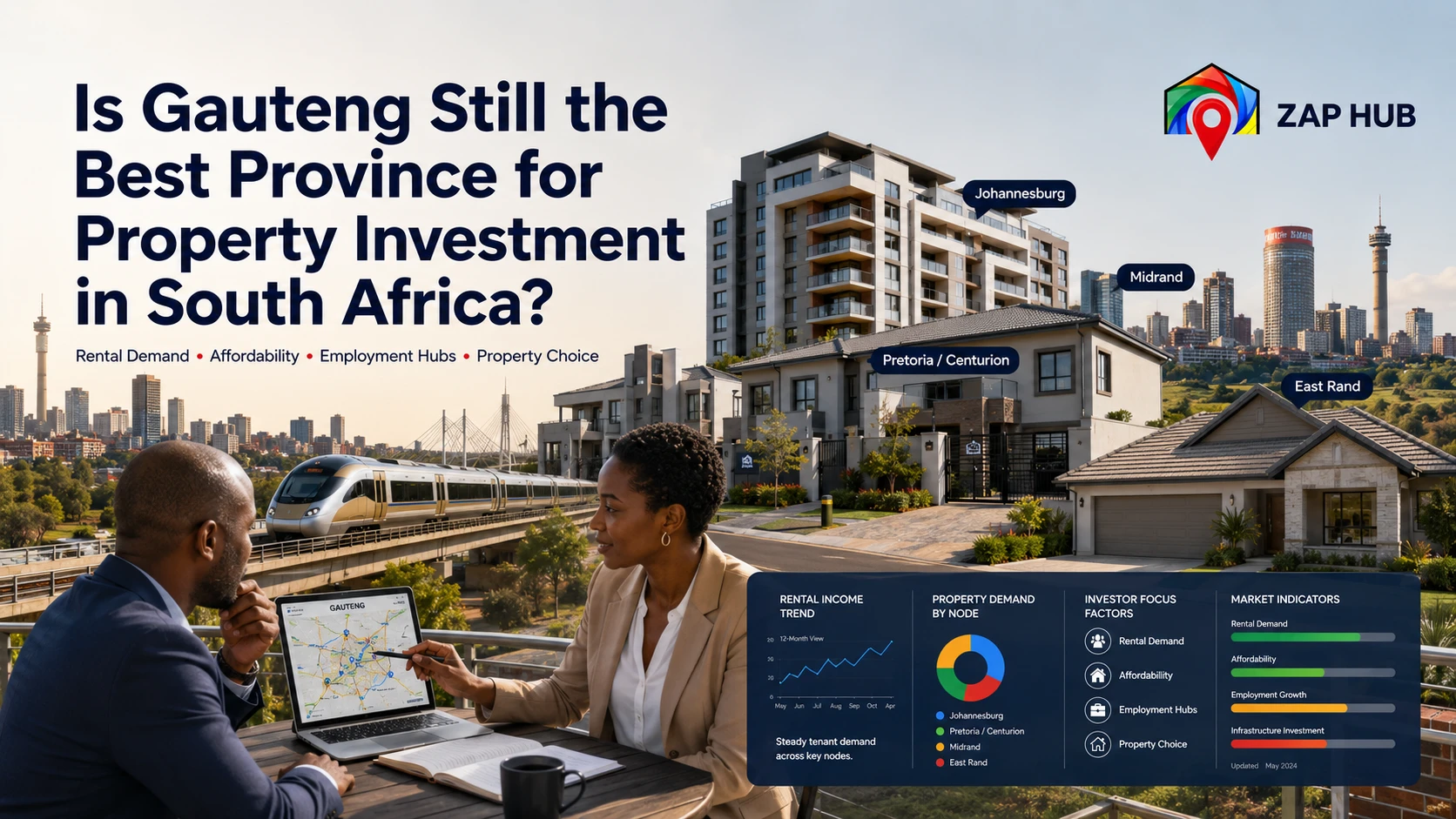
For decades, Gauteng has been one of South Africa’s most important property-investment markets. Johannesburg, Pretoria, Midrand, Centurion and the East Rand provide access to the country’s largest concentration of businesses, employment opportunities, universities, transport networks and residential tenants.
But is Gauteng still the best province for property investment?
The most accurate answer is that Gauteng remains one of South Africa’s strongest provinces for rental demand, affordability and property choice, but it is not automatically the best province for every investment strategy.
Recent official property-price data illustrates this distinction. Statistics South Africa reported that national residential property prices increased by 7.8% year-on-year in January 2026, while Gauteng recorded growth of approximately 4.5%. Gauteng therefore showed positive growth, but it did not lead the country’s provincial capital-appreciation rankings during that period.
Investors can start by exploring Gauteng properties for sale on ZAP HUB and comparing opportunities across Johannesburg, Pretoria, Midrand, Centurion and the East Rand.
Why Gauteng Remains Important to Property Investors
Gauteng’s investment strength comes from the size and diversity of its economy rather than one lifestyle trend.
The province includes:
- Major corporate headquarters
- Government and diplomatic employment
- Universities and colleges
- Industrial and logistics centres
- Healthcare facilities
- Technology and financial-services hubs
- Extensive residential rental markets
- Entry-level and luxury properties
- Established suburbs and new developments
This creates demand from students, professionals, families, contractors, public-sector employees and people relocating for work.
Unlike a market driven mainly by holiday buyers or premium semigration, Gauteng supports several investment models across multiple price bands.
Gauteng’s Main Advantage: A Large Tenant Market
For many investors, Gauteng’s greatest strength is not rapid price appreciation. It is the size of its rental market.
Johannesburg, Pretoria, Centurion, Midrand and Ekurhuleni contain thousands of tenants who need accommodation close to:
- Employment centres
- Universities
- Schools
- Public transport
- Gautrain stations
- Hospitals
- Industrial areas
- Shopping and commercial nodes
This gives investors opportunities in:
- Entry-level apartments
- Townhouses
- Family homes
- Student accommodation
- Shared accommodation
- Luxury rentals
- Retirement developments
- Residential estate properties
National rental reporting entering 2026 showed continued rental growth, with average rents rising above inflation during parts of 2025. This supports the investment case for correctly priced properties in areas with genuine tenant demand.
However, a large rental market does not guarantee that every unit will perform well. Tenant demand can differ substantially between neighbouring suburbs and even between buildings on the same street.
Gauteng May Offer Better Yields Than Premium Coastal Markets
Property prices in parts of Gauteng remain comparatively accessible relative to premium areas of Cape Town and the KwaZulu-Natal North Coast.
This may allow an investor to achieve a stronger relationship between:
- Purchase price
- Monthly rental income
- Levies
- Municipal rates
- Maintenance costs
A lower purchase price can produce a better gross rental yield, but only where the property attracts reliable tenants and operating costs remain controlled.
A 2026 international rental-market comparison placed South Africa’s average gross residential rental yield at approximately 11.53% during the second quarter. Its comparison included Johannesburg and Centurion, although actual yields vary widely by suburb, property type and calculation method. Gross yield also excludes finance, tax, vacancies, management and maintenance.
Investors should calculate both gross and net yield rather than relying on a headline percentage.
What Is a Gross Rental Yield?
Gross rental yield compares annual rent with the property’s purchase price.
A simplified calculation is:
Annual rental income ÷ Purchase price × 100
For example, a property purchased for R1,000,000 and rented for R9,000 per month produces annual rent of R108,000.
The approximate gross yield would be:
R108,000 ÷ R1,000,000 × 100 = 10.8%
This does not account for:
- Levies
- Rates and taxes
- Insurance
- Maintenance
- Management fees
- Vacancy periods
- Unpaid rent
- Bond interest
- Income tax
- Transfer and bond costs
The net yield may therefore be significantly lower.
Johannesburg: Scale, Choice and Uneven Performance
Johannesburg provides one of South Africa’s broadest selections of investment property.
Potential markets include:
- Sandton
- Rosebank
- Randburg
- Fourways
- Bryanston
- Midrand
- Johannesburg South
- Roodepoort
- Bedfordview
- Selected inner-city areas
Its strongest advantage is variety. Investors can evaluate affordable apartments, townhouses, freestanding homes, luxury rentals and mixed-use developments.
However, Johannesburg performance is highly selective. A secure townhouse close to employment and transport may perform differently from an oversupplied apartment or a poorly managed inner-city building.
Important checks include:
- Vacancy levels
- Security
- Building finances
- Body-corporate management
- Special levies
- Competing rental supply
- Tenant payment history
- Municipal accounts
- Planned local development
Market commentary for Johannesburg in 2026 describes the outlook as positive but uneven, with better-managed and well-located properties expected to outperform weaker buildings and declining nodes.
Explore Johannesburg properties for sale on ZAP HUB.
Pretoria: Stable Demand Across Several Tenant Groups
Pretoria benefits from government departments, embassies, universities, healthcare institutions and corporate employment.
Popular investment areas may include:
- Pretoria East
- Hatfield
- Menlyn
- Brooklyn
- Montana
- Moot
- Centurion
- Pretoria North
Different locations support different strategies. Hatfield may attract students and young professionals, while Pretoria East and Centurion can appeal to families and corporate tenants.
Property24 market reporting published in June 2026 placed Pretoria East’s average asking price at approximately R1.85 million and its average selling price at around R1.58 million. The same report placed the 2025 average sale price for sectional-title units in the area at approximately R1.17 million. These figures are broad market indicators rather than valuations for individual properties.
The gap between asking and selling prices also shows why investors should negotiate according to comparable sales and rental performance rather than the advertised price alone.
Midrand and Centurion: Employment and Infrastructure Corridors
Midrand and Centurion remain prominent investment locations because they connect Johannesburg and Pretoria.
They offer access to:
- Corporate offices
- Gautrain services
- Major highways
- Schools
- Retail centres
- Business parks
- Technology and logistics employers
- New residential developments
Popular property types include:
- One- and two-bedroom apartments
- Townhouses
- Secure-estate homes
- Family houses
- Lock-up-and-go units
The main risk is development supply. Where many similar apartments enter the market simultaneously, landlords may face competition, incentives, slower rental growth or periods of vacancy.
Investors should compare the number of available rentals with actual tenant demand before buying into a new development.
The East Rand: Affordability and Industrial Rental Demand
The East Rand may appeal to investors seeking relatively affordable property near industrial, aviation, manufacturing and logistics employment.
Important markets include:
- Germiston
- Boksburg
- Benoni
- Alberton
- Edenvale
- Kempton Park
- Brakpan
- Springs
Investment demand can be supported by proximity to:
- OR Tambo International Airport
- Logistics corridors
- Industrial areas
- Manufacturing employers
- Schools and shopping centres
- Major highways
Explore East Rand properties for sale on ZAP HUB.
East Rand properties may offer lower entry prices than premium northern Johannesburg suburbs, but investors must investigate security, municipal services, maintenance and street-level tenant demand.
Sandton, Rosebank and Northern Johannesburg
Premium Johannesburg nodes attract executives, corporate tenants, professionals and international residents.
Potential advantages include:
- Strong commercial infrastructure
- Gautrain access
- Modern developments
- Corporate rental demand
- High-quality amenities
- International tenant appeal
Potential risks include:
- High purchase prices
- Expensive levies
- Apartment oversupply
- Competition from serviced accommodation
- High vacancy costs
- Slower yields on luxury units
A premium property may achieve a high monthly rent but still produce a modest yield if the purchase price and ownership expenses are excessive.
Investors should not confuse an impressive address with a profitable investment.
Student Accommodation Can Offer Demand but Requires Management
Gauteng’s universities and colleges create demand around areas such as:
- Hatfield
- Braamfontein
- Auckland Park
- Melville
- Doornfontein
- Pretoria Central
- Johannesburg Central
Student property can produce attractive income where it is properly located and professionally operated.
Investors should assess:
- Accreditation requirements
- Safety and security
- Public transport
- Wi-Fi and utility costs
- Furnishing expenses
- Room occupancy
- House rules
- Property management
- Seasonal vacancies
- Building and zoning compliance
Student accommodation is an operating business, not merely a passive residential rental.
Is Gauteng Best for Capital Growth?
Not necessarily.
Recent official data shows that Gauteng’s property-price growth has been positive but below faster-growing provinces during certain reporting periods.
The Western Cape has benefited from semigration, constrained stock and premium coastal demand. KwaZulu-Natal’s North Coast has also attracted lifestyle and estate buyers.
Gauteng’s advantage is different. Investors may be able to buy at a more accessible price and earn a stronger rental yield while waiting for gradual capital growth.
A reasonable Gauteng strategy may therefore prioritise:
- Sustainable rental income
- Discounted acquisition
- Value-adding renovations
- Reliable tenants
- Long-term holding
- Carefully selected growth nodes
Investors seeking rapid, broad-based appreciation may find stronger historical performance elsewhere, but possibly at a much higher entry price.
How Interest Rates Affect Gauteng Investment
South Africa’s repo rate was held at 7% in July 2026, with the prime lending rate at 10.5%. Finance therefore remains a major investment expense.
An investment that appears profitable before finance costs can become cash-flow negative after adding:
- Bond repayments
- Levies
- Rates
- Insurance
- Management
- Maintenance
- Vacancy
- Tax
Investors should test the property at its actual approved interest rate and should also model the effect of future repayment increases.
The ZAP HUB bond calculator can assist with preliminary repayment estimates, while the affordability calculator can help buyers evaluate an initial purchasing range. Final lending terms must be confirmed with the bank or bond professional.
Gauteng Investment Risks to Consider
Municipal and infrastructure concerns
Electricity, water, roads, billing and maintenance can influence tenant demand and resale value.
Oversupply
Some apartment markets contain many similar units competing for the same tenants.
High sectional-title costs
Levies, special levies and building repairs can reduce the investor’s net return.
Security expenditure
Security may increase both demand and monthly ownership costs.
Weak property management
Poor tenant screening, delayed maintenance and unpaid rent can quickly damage cash flow.
Location differences
Provincial or city-level averages can hide declining streets, poorly managed buildings and areas with limited rental demand.
Concentration risk
An investor who owns several properties in one development is exposed to the same body corporate, neighbourhood and tenant market.
What Makes a Strong Gauteng Investment Property?
A suitable investment commonly has:
- A realistic purchase price
- Proven tenant demand
- Access to employment or education
- Reliable transport connections
- Manageable levies and rates
- Adequate security
- Good physical condition
- Functional layout
- Competitive rent
- Low expected vacancy
- A well-managed body corporate, where applicable
- Reasonable resale demand
Properties should be evaluated individually rather than selected only because they are in Gauteng.
Gauteng Versus Other Provinces
Gauteng
Best known for:
- Broad rental demand
- Employment-based tenancies
- Affordable entry opportunities
- Large property selection
- Potentially attractive yields
Main concern:
- Uneven capital growth and municipal performance
Western Cape
Best known for:
- Strong historical capital growth
- Semigration
- Lifestyle demand
- Limited stock in premium areas
Main concern:
- High purchase prices and lower affordability
KwaZulu-Natal
Best known for:
- North Coast estate growth
- Coastal lifestyle demand
- Retirement and holiday markets
- Range of affordable and premium properties
Main concern:
- Highly location-specific performance and coastal maintenance
Eastern Cape
Best known for:
- Selected affordable coastal and family markets
- Student and industrial demand in major centres
Main concern:
- Smaller and less liquid markets outside primary cities
There is no universally superior province. The correct choice depends on whether the investor prioritises income, appreciation, affordability, personal use or portfolio diversification.
Questions Investors Should Ask Before Buying
- What rent are comparable properties actually achieving?
- How long do similar rentals remain vacant?
- What are the total monthly levies and rates?
- Are special levies planned?
- Is the building financially well managed?
- What maintenance will be required immediately?
- Is the asking price supported by registered sales?
- What tenant group does the property serve?
- Is new competing stock being developed nearby?
- What is the expected net yield after all expenses?
- Can the investment withstand a vacancy or rate increase?
- Is there realistic resale demand?
A property inspector, valuer, conveyancer, tax professional and rental specialist may help assess these risks. Investors can use the ZAP HUB service-provider search to find relevant property professionals by category and location.
So, Is Gauteng Still the Best Province?
Gauteng can still be the best province for an investor seeking:
- Rental income
- Affordable entry points
- Employment-driven demand
- A large tenant pool
- Multiple property types
- Opportunities to negotiate
- Long-term urban investment
It may not be the best choice for an investor whose main goal is premium coastal appreciation, lifestyle ownership or semigration-driven growth.
The more useful question is not whether Gauteng is universally the best province. It is whether a specific Gauteng property delivers the right combination of price, rent, expenses, risk and future demand.
Final Thoughts
Gauteng remains one of South Africa’s most important property-investment provinces in 2026. Its case is supported by employment, population density, tenant demand, infrastructure and a wide range of relatively accessible properties.
However, investors must be selective. Gauteng’s performance differs between Johannesburg, Pretoria, Midrand, Centurion and the East Rand—and between individual suburbs, complexes and streets.
The strongest opportunity may be a correctly priced property in a proven rental node rather than the newest development or most prestigious address.
Explore Gauteng properties for sale on ZAP HUB and compare opportunities according to purchase price, realistic rent, ownership costs and long-term demand.
- Gauteng properties for sale
https://zaphub.co.za/residential-properties-for-sale/south-africa/gauteng - Johannesburg properties for sale
https://zaphub.co.za/residential-properties-for-sale/south-africa/gauteng/johannesburg - East Rand properties for sale
https://zaphub.co.za/residential-properties-for-sale/south-africa/gauteng/east-rand - Search property-service providers
https://zaphub.co.za/service-providers/search - Browse service-provider categories
https://zaphub.co.za/service-providers/categories - Bond calculator
https://zaphub.co.za/bond-calculator - Affordability calculator
https://zaphub.co.za/affordability-calculator
Frequently Asked Questions
1. Is Gauteng still a good province for property investment?
Yes. Gauteng offers a large tenant market, employment-based demand, diverse property types and comparatively accessible entry prices. Investment quality still depends on the specific area and property.
2. Is Gauteng the fastest-growing property province?
Not according to every recent price index. Official data has shown positive Gauteng growth but stronger appreciation in some other provinces during certain periods.
3. Is Johannesburg good for rental-property investment?
Johannesburg offers substantial rental demand, but performance varies greatly between suburbs and buildings. Security, vacancy, levies and management are important.
4. Is Pretoria suitable for property investors?
Pretoria supports government, diplomatic, university, healthcare and family rental markets. Areas such as Pretoria East, Hatfield and Centurion serve different tenant groups.
5. Where can investors find affordable Gauteng property?
Depending on location and condition, relative affordability may be found in parts of the East Rand, Johannesburg South, Pretoria North, Roodepoort, Germiston, Boksburg, Benoni and Springs.
6. Does Gauteng offer better rental yields than Cape Town?
Some Gauteng properties may offer higher gross yields because purchase prices are lower relative to rent. Actual net returns depend on levies, rates, vacancy, finance and maintenance.
7. What is a good rental yield?
There is no universal figure. Investors should compare the net yield with financing costs, risk, alternative investments and local market performance.
8. Are new developments good investments?
They may offer low maintenance and attractive amenities, but investors should investigate oversupply, developer pricing, levies, transfer arrangements and rental competition.
9. Is sectional-title property a good Gauteng investment?
It can be, particularly for apartments and townhouses. Investors must inspect the body corporate’s finances, rules, reserve fund and special-levy history.
10. Should investors buy near Gautrain stations?
Transport access can support demand, but investors must still examine the immediate neighbourhood, purchase price, rent, levies and competing supply.
11. Is the East Rand suitable for rental investment?
Selected East Rand areas may benefit from airport, industrial and logistics employment. Street-level research, security and municipal-service checks remain essential.
12. Can rental income cover the full bond repayment?
It may or may not. Investors must include levies, rates, vacancies, maintenance, insurance and management before determining cash flow.
13. Should I choose Gauteng or the Western Cape?
Gauteng may offer better affordability and yields, while the Western Cape has delivered stronger capital growth in many recent periods. The choice depends on the investor’s objective and budget.
14. Where can I find Gauteng property professionals?
Use the ZAP HUB service-provider search to explore valuers, inspectors, conveyancers, rental professionals and other service providers.
Call to Action
Explore Gauteng Investment Properties
Compare apartments, townhouses, family homes, secure-estate properties and rental opportunities across Gauteng.
Browse Gauteng Properties on ZAP HUB
Need Help Evaluating an Investment?
Find professionals who may assist with:
- Property valuation
- Rental assessments
- Conveyancing
- Bond applications
- Property inspections
- Tax planning
- Property management
- Repairs and maintenance
- Insurance
Search ZAP HUB Service Providers
Disclaimer
This article provides general property-market education and does not constitute financial, investment, tax, legal, lending, rental, valuation or property advice. Property prices, rental income, vacancy, interest rates and ownership costs may change. Gross yield does not represent net profit and excludes several expenses. Investors should conduct independent due diligence and consult suitably qualified property practitioners, valuers, conveyancers, lenders, tax professionals and financial advisers. ZAP HUB does not guarantee rental income, capital appreciation, tenant performance, finance approval or investment returns.