
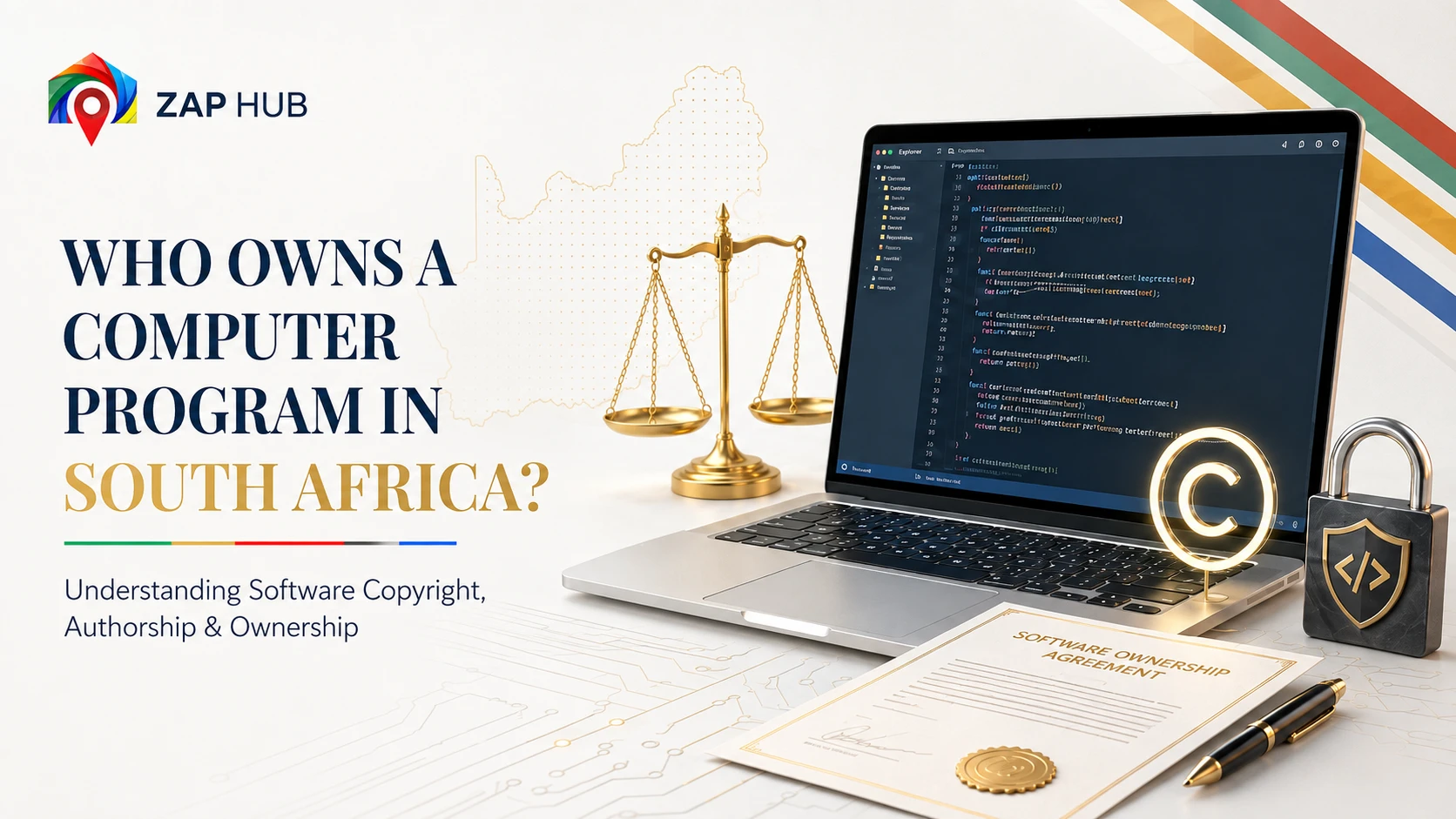
In today’s digital economy, businesses increasingly depend on websites, mobile applications, software platforms, APIs, artificial intelligence tools and customised computer programs.
But an important question is often overlooked until a dispute arises:
Who actually owns the software once it has been developed?
A business may come up with the idea, finance the project, provide the requirements and pay a developer to build the software. It may therefore seem logical that the business automatically owns everything that has been created.
Under South African copyright law, however, the answer is not always that simple.
When there is no clear agreement between a developer and the person or company commissioning the software, determining ownership may depend on who legally qualifies as the author of the computer program.
And when it comes to computer programs, South African law places considerable importance on one concept:
Control.
How Does Copyright Protect Computer Programs in South Africa?
Copyright is a form of intellectual property protection governed primarily by the Copyright Act 98 of 1978, as amended.
South African copyright law recognises computer programs as works capable of copyright protection. The Companies and Intellectual Property Commission (CIPC) also confirms that computer programs are among the categories of works protected by copyright.
Unlike patents, trademarks and registered designs, copyright protection for most works does not depend on completing a formal registration process.
Copyright generally arises automatically once an eligible original work has been created and reduced to material form. CIPC confirms that, apart from cinematograph films, copyright works generally do not require registration to receive protection.
This means that source code and qualifying computer programs may enjoy copyright protection without the developer or business first registering them with CIPC.
What Is a Computer Program Under South African Copyright Law?
The Copyright Act treats computer programs as a distinct category of copyright work.
More importantly for ownership disputes, the Act contains a special definition of the author of a computer program.
For a computer program, the author is:
the person who exercised control over the making of the computer program.
This is different from simply asking:
Who physically typed the code?
A programmer may write thousands of lines of source code but may not necessarily be regarded as the author for copyright purposes if another party exercised sufficient control over how the program was being developed.
Who Is Normally the Copyright Owner?
Section 21 of the Copyright Act provides the general rule that copyright ownership initially vests in the author, subject to certain exceptions.
For software development, there are three common situations.
1. A Developer Creates Software Independently
Imagine a software developer creates an application using their own concept, resources and technical expertise without being employed or commissioned by another party.
The developer will ordinarily exercise control over the creation of the program.
In this situation, the developer is likely to be both the author and initial copyright owner.
2. An Employee Develops Software for Their Employer
The position can be different where a programmer develops software while working as an employee.
Section 21(1)(d) of the Copyright Act provides that where qualifying work is created in the course of employment under a contract of service or apprenticeship, the employer will generally own the copyright, subject to any agreement providing otherwise.
Businesses should therefore ensure that employment contracts clearly address intellectual property created by developers, engineers, designers and other technical employees.
3. An Independent Developer Is Commissioned to Build Software
This is where disputes commonly arise.
A company may identify a problem and hire an independent software developer or development company to create:
- a mobile application;
- a website;
- an ERP or CRM platform;
- an AI application;
- a property platform;
- an e-commerce system;
- customised business software; or
- another digital product.
The company pays for the development.
Does payment automatically mean the company owns the copyright?
Not necessarily.
The Copyright Act contains special ownership rules for certain commissioned works, but the list in section 21(1)(c) does not simply provide a blanket rule making the commissioner the copyright owner of every commissioned computer program.
When commissioned software is involved, the contractual arrangement and the question of who exercised control over the making of the program can therefore become extremely important.
The Importance of Control: Haupt v Brewers Marketing Intelligence
One of South Africa’s leading cases dealing with copyright ownership in computer programs is:
Haupt t/a Soft Copy v Brewers Marketing Intelligence (Pty) Ltd and Others (118/05) [2006] ZASCA 40; 2006 (4) SA 458 (SCA).
The Supreme Court of Appeal examined what it means to exercise “control” over the creation of a computer program.
The programmer performed the technical coding work, but the person overseeing the project:
- gave detailed instructions;
- communicated regularly with the developer;
- specified the required results;
- reviewed the developer’s work;
- approved progress;
- could determine the direction of further development; and
- had authority over the development process.
The Court recognised that a person does not need to know how to write computer code to exercise control over the making of a computer program.
The important question was whether that person had sufficient authority and direction over the development process.
On the relevant software development considered by the Court, this level of involvement was sufficient to establish control.
The case established an important principle:
Technical programming ability and legal authorship are not necessarily the same thing.
A programmer may perform the technical work while another person exercises the level of control required for authorship.
Bergh v Agricultural Research Council: Testing Is Not Necessarily Control
The Supreme Court of Appeal considered the issue again in:
Bergh and Others v The Agricultural Research Council (93/2019) [2020] ZASCA 30.
The dispute concerned a cattle-management software program known as BeefPro.
The Agricultural Research Council argued that it exercised sufficient control over development of the program to establish copyright ownership.
The evidence, however, showed that the developer worked largely independently and applied his own skills and experience.
Although the organisation provided information concerning what the software needed to accomplish and was involved in reviewing or testing the program, the developer:
- was not working under continuous supervision;
- was not required to obtain ongoing approval;
- did not receive detailed technical or development instructions; and
- independently determined how the software would be developed.
The Supreme Court of Appeal found that the ARC had failed to prove that it exercised the necessary control over development of the software.
Importantly, the Court explained that merely providing functional requirements, periodically reviewing progress and eventually testing whether a program performs its intended purpose will not necessarily amount to control over the making of the program.
Giving Requirements Is Different From Controlling Development
This distinction is extremely important for businesses commissioning software.
Imagine a company tells a developer:
“We need an application that allows customers to search properties, save favourites and contact estate agents.”
The developer independently decides:
- which technology stack to use;
- how the database should be structured;
- how the application architecture should work;
- how the features should interact;
- how development should proceed; and
- when and how technical changes should be implemented.
The company occasionally reviews demonstrations and reports bugs.
That may not necessarily amount to the level of control contemplated by the Copyright Act.
Compare this with a business that:
- prepares detailed specifications;
- defines individual functionality;
- establishes development milestones;
- regularly reviews builds;
- approves or rejects features;
- directs changes;
- determines development priorities;
- maintains detailed project records; and
- has authority to stop, modify or redirect development.
Those circumstances may provide considerably stronger evidence of control.
Ultimately, however, each case will depend on its particular facts.
Paying for Software Does Not Automatically Mean Owning It
This is perhaps the most important lesson for South African businesses.
Payment and copyright ownership are two different things.
Paying R50,000, R500,000 or even several million rand for the development of software does not necessarily answer the copyright ownership question.
The best solution is therefore not to rely on arguments about who controlled development after a dispute occurs.
Ownership should be agreed before development begins.
Put Software Ownership in Writing
A properly drafted software development agreement should clearly establish what happens to intellectual property.
Depending on the commercial arrangement, the agreement should address issues such as:
- ownership of the source code;
- copyright ownership;
- intellectual property created during development;
- pre-existing code owned by the developer;
- third-party libraries;
- open-source software;
- database ownership;
- designs and user interfaces;
- APIs and integrations;
- documentation;
- future improvements;
- modifications and upgrades;
- licensing rights;
- developer reuse rights;
- confidentiality;
- access to repositories;
- source-code handover; and
- rights after termination of the relationship.
South African law also provides that an assignment of copyright must be in writing and signed by or on behalf of the person assigning the copyright for the assignment to have effect.
For that reason, simply stating verbally that “the software belongs to the client” may expose both parties to unnecessary risk.
Keep Accurate Development Records
Where software ownership could potentially become disputed, documentation can be extremely valuable.
Businesses commissioning software should consider retaining records of:
- project specifications;
- scope-of-work documents;
- development agreements;
- emails containing instructions;
- project-management tickets;
- approval records;
- meeting notes;
- version histories;
- Git or repository records;
- milestone approvals;
- design documents;
- change requests;
- testing reports; and
- communications directing development.
These records can help establish who actually directed and controlled the development process.
Control Is Important — But a Contract Is Better
The decisions in Haupt and Bergh demonstrate how complicated software copyright disputes can become when ownership has not been clearly agreed.
One case demonstrated that detailed direction, approval and authority over development could establish sufficient control.
The other demonstrated that providing requirements and testing the finished product, without more, may not be enough.
For companies, entrepreneurs and developers, the practical lesson is straightforward:
Do not wait for a copyright dispute to determine who owns your software.
Agree on ownership before development starts.
Record that agreement in writing.
Clearly distinguish between ownership of the final software, source code, reusable developer components, third-party code and future developments.
And maintain proper records throughout the development process.
Because once a computer program becomes commercially successful, the question of who owns it can become significantly more valuable—and significantly more contentious.
Frequently Asked Questions
Does the person who writes the code automatically own it?
Not necessarily.
For computer programs, South African copyright law defines the author by reference to the person who exercised control over the making of the program. The individual physically writing the code and the legal author may therefore not always be the same person.
If I pay a developer to build an app, do I automatically own the source code?
Not necessarily.
Payment alone should not be relied upon as proof of ownership. The development agreement, employment relationship, copyright assignment and degree of control over development may all be relevant.
The safest approach is to expressly regulate ownership and source-code rights in a written contract.
Who owns software created by an employee?
Where qualifying copyright work is created in the course and scope of employment under a contract of service, the employer will generally own the copyright, subject to agreements providing otherwise.
Can software copyright be transferred?
Yes.
Copyright can be assigned, but an assignment must comply with the Copyright Act. In particular, an assignment of copyright must be recorded in writing and signed by or on behalf of the assignor.
Do I need to register software copyright in South Africa?
Generally, no.
CIPC states that copyright protection for eligible works generally arises automatically upon creation and that only cinematograph films are subject to its copyright-registration process. Computer programs are recognised as copyright-protected works.
Final Takeaway
When it comes to computer programs in South Africa:
Writing the code does not always determine authorship.
Paying for the code does not automatically determine ownership.
Testing the program does not necessarily establish control.
What matters is the legal and factual relationship between the parties—including who exercised control over the development process and what the parties agreed regarding intellectual property.
For businesses commissioning valuable software, the best protection is simple:
Define ownership before development starts, put the agreement in writing and keep detailed records throughout the project.
Legal Disclaimer
This article is intended for general information and educational purposes and does not constitute legal advice. Software copyright disputes can depend heavily on the particular contractual arrangements and facts involved. Businesses and developers should obtain advice from a South African intellectual property attorney concerning their specific circumstances.
Legislative note: This article reflects the existing Copyright Act framework and leading South African case law as at September 2026. South Africa’s Copyright Amendment Bill remains part of an ongoing reform process following the Constitutional Court’s June 2026 judgment concerning provisions of the Bill.
Key Legal References
- Copyright Act 98 of 1978, as amended.
- Haupt t/a Soft Copy v Brewers Marketing Intelligence (Pty) Ltd and Others (118/05) [2006] ZASCA 40; 2006 (4) SA 458 (SCA).
- Bergh and Others v The Agricultural Research Council (93/2019) [2020] ZASCA 30.
- CIPC guidance regarding copyright protection in South Africa.