
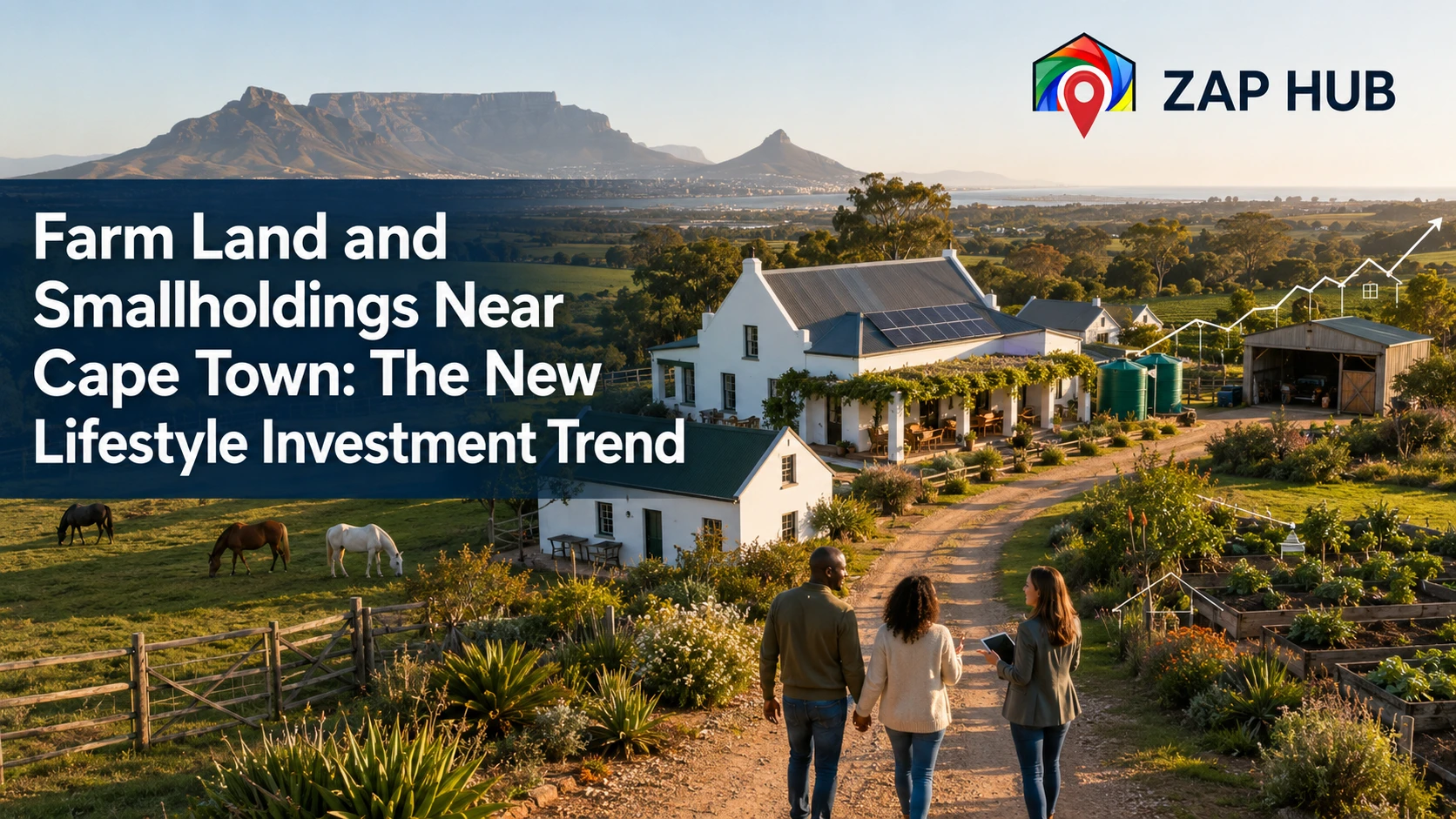
As urban property prices rise and flexible working changes how people choose where to live, farmland and smallholdings near Cape Town are attracting a new category of buyer.
These purchasers are not necessarily conventional commercial farmers.
Many are families, entrepreneurs, remote professionals, equestrian buyers, hospitality operators and investors looking for properties that can combine:
- A primary residence
- More outdoor space
- Small-scale agriculture
- Additional rental accommodation
- Guest or tourism facilities
- Equestrian use
- Workshops or studios
- Renewable-energy systems
- A long-term lifestyle investment
Areas such as Philadelphia, Cape Farms, Klipheuwel, Durbanville Rural, Joostenbergvlakte, Paarl Rural, Wellington, Malmesbury and the Riebeek Valley offer different versions of country living within practical reach of Cape Town.
Current property inventory confirms that this is a diverse and active segment. Property24 currently carries Western Cape farm listings across Cape Town, the Winelands, the West Coast and surrounding rural districts, while Pam Golding lists hundreds of Western Cape country-living properties.
However, the term lifestyle investment requires care.
A smallholding may offer privacy, land and income potential, but it also carries responsibilities that do not apply to an ordinary suburban home. Water, zoning, access, agricultural restrictions, security, fire risk, infrastructure and maintenance can materially affect both the lifestyle and investment outcome.
The strongest opportunity is therefore not simply a large piece of land near Cape Town. It is a property with lawful use rights, dependable infrastructure, realistic operating costs and a location that future buyers or tenants are likely to value.
Why Are Buyers Looking Beyond Cape Town’s Suburbs?
Cape Town continues to experience strong residential demand and limited housing supply. Pam Golding reported that the Western Cape accounted for 44.3% of residential building plans passed during the measured portion of 2025, while ongoing semigration and investment demand continued supporting the Cape Town market.
As conventional suburban property becomes more expensive, some buyers are considering whether the same budget could provide more land and flexibility outside the urban core.
A smallholding may offer:
- A larger main residence
- Space for extended family
- One or more cottages
- A home office
- Gardens or orchards
- Paddocks
- Workshops
- Storage
- Tourism potential
- Greater privacy
- Partial off-grid capability
The appeal is not always about paying less.
Many smallholdings near Cape Town cost substantially more than an average suburban home. The attraction lies in obtaining a different type of property—one that combines residential, lifestyle and potential income-producing uses.
What Is a Smallholding?
A smallholding is generally a rural or semi-rural property larger than a conventional residential erf but smaller than many full-scale commercial farms.
There is no single property size that automatically defines a smallholding.
Properties marketed in this category may range from approximately one hectare to several dozen hectares, depending on the area and land-use classification.
A smallholding may be used for:
- Residential living
- Horses or livestock
- Market gardening
- Olive or fruit cultivation
- Nurseries
- Workshops
- Kennels
- Guest accommodation
- Events
- Storage
- Small-scale agricultural production
The permitted use depends on zoning, title-deed conditions, municipal rules and environmental requirements.
A property being marketed as a “lifestyle farm” does not automatically mean every intended business activity is legally allowed.
Why Is This Becoming a Lifestyle Investment Trend?
Remote and hybrid work have expanded location choice
Some professionals no longer need to commute into central Cape Town every day.
This makes areas outside the traditional suburban boundary more practical, provided the property offers:
- Reliable internet
- A suitable home office
- Backup power
- Secure access
- Reasonable road connections
- Access to schools and services
A buyer who travels into Cape Town only once or twice a week may accept a longer commute in exchange for land, privacy and lifestyle benefits.
Families want more space
Smallholdings can accommodate:
- Children
- Pets
- Horses
- Extended family
- Vegetable gardens
- Workshops
- Recreational facilities
- Multiple vehicles
This can be difficult or prohibitively expensive to achieve in established Cape Town suburbs.
Buyers are seeking income diversification
A well-configured smallholding may support more than one income stream through:
- Long-term cottage rentals
- Equestrian facilities
- Guest accommodation
- Events
- Storage
- Workshops
- Agricultural production
- Kennels
- Nurseries
- Farm stalls
- Wellness or retreat activities
These possibilities should be treated as business opportunities requiring due diligence—not as guaranteed returns.
Sustainability has become more important
Rural buyers increasingly prioritise:
- Boreholes
- Water storage
- Solar power
- Backup systems
- Food gardens
- Composting
- Rainwater harvesting
- Energy-efficient buildings
Some current Cape Town farm listings specifically promote off-grid systems, boreholes and water availability as significant property features.
Land supply near Cape Town is limited
Land close enough to Cape Town for regular access is finite.
Urban growth, infrastructure needs, environmental controls and agricultural protection can constrain new supply.
This scarcity may support long-term value for correctly located properties, although land ownership does not guarantee strong appreciation.
Where Are Buyers Looking?
Philadelphia
Philadelphia is one of the most visible smallholding and country-living markets north of Cape Town.
The village and surrounding agricultural areas provide access to:
- The N7
- Durbanville
- Melkbosstrand
- Malmesbury
- Cape Town’s northern suburbs
- West Coast employment and tourism routes
Current Property24 inventory for Philadelphia includes a mixture of conventional village homes and farms ranging from roughly one hectare to several hundred hectares. Recent examples have included a 7.1-hectare property around R7 million and an approximately 7.96-hectare gated farming property near R10 million. These are individual asking prices rather than market averages.
A July 2026 listing described a seven-hectare Philadelphia smallholding as a versatile lifestyle and agricultural property, illustrating how the area is being marketed to buyers seeking both residential and productive use.
Why Philadelphia appeals
- Country atmosphere
- Access to the N7
- Equestrian potential
- Agricultural land
- Larger properties
- Proximity to Durbanville
- Access to Cape Town
- Guesthouse and hospitality possibilities
- Gated smallholding communities
What buyers should investigate
- Road condition and travel time
- Borehole output
- Agricultural zoning
- Security
- Eskom or alternative power
- Fire management
- Soil suitability
- Building approvals
- Rental and hospitality rights
Cape Farms
“Cape Farms” is a broad property-search area covering agricultural and semi-rural land within Cape Town’s wider municipal area.
Current Cape Town farm inventory includes properties ranging from smaller residential holdings to large agricultural parcels. Recent listings have included approximately 1.6-hectare, seven-hectare, ten-hectare and 17-hectare properties, with uses ranging from equestrian and kennel operations to off-grid lifestyle living.
Typical opportunities
- Equestrian properties
- Kennels or animal facilities
- Multiple dwellings
- Small-scale farming
- Storage
- Nursery operations
- Hospitality
- Residential compounds
- Land banking, subject to planning restrictions
The closer a farm is to expanding urban development, the more important it becomes to verify future planning, road proposals and development rights.
Owning agricultural land near urban expansion does not automatically give the owner a right to rezone or subdivide it.
Durbanville Rural and Klipheuwel
The rural areas beyond Durbanville can appeal to buyers who want country living while maintaining access to:
- Durbanville schools
- Shopping centres
- Medical facilities
- Cape Town International Airport
- Northern-suburb employment
- Stellenbosch and Paarl routes
Current agency coverage identifies Cape Farms, Durbanville, Klipheuwel and Philadelphia as connected rural property markets.
Properties may include:
- Equestrian smallholdings
- Vineyards
- Lifestyle farms
- Cottages
- Agricultural land
- Warehousing or workshops where permitted
- Properties with income-producing units
Entry prices can be high because of proximity to Cape Town and Durbanville’s established residential market.
A current agency portfolio has included a Durbanville Rural smallholding of more than 21 hectares with a main house, cottages and boreholes, demonstrating the scale and infrastructure available in this segment.
Joostenbergvlakte and Fisantekraal
Joostenbergvlakte and nearby rural areas may suit:
- Equestrian buyers
- Contractors
- Nursery operators
- Families requiring space
- Buyers with workshops
- Small-scale farmers
- Investors seeking multi-dwelling properties
Their location provides access to Durbanville, Kraaifontein, Brackenfell, Paarl and Stellenbosch routes.
However, buyers should carefully examine:
- Zoning
- Informal structures
- Road access
- Security
- Water
- Electrical supply
- Neighbouring land uses
- Commercial activity
- Future development
The property may feel rural while being influenced by nearby industrial, residential or infrastructure expansion.
Malmesbury and the Swartland
Malmesbury is farther from central Cape Town than Philadelphia but offers a more established agricultural environment and potentially more land for the budget.
Current Property24 inventory includes approximately 29 farms in the Malmesbury market, alongside houses, vacant land, commercial and industrial property. Recent listings have included a 20-hectare farm around R4.9 million and larger productive farms exceeding 100 hectares.
Why Malmesbury attracts lifestyle investors
- Larger agricultural properties
- Established farming economy
- Access to Cape Town through the N7
- Proximity to Philadelphia
- Schools and town services
- Agricultural-business potential
- Space for horses and livestock
- Relative value compared with the Winelands
Potential uses
- Grain or pasture production
- Small livestock
- Equestrian facilities
- Guest accommodation
- Farm-based businesses
- Residential lifestyle use
- Long-term cottages
Commercial farming assumptions should be tested against soil, rainfall, equipment and operating costs.
Paarl Rural and Wellington
Paarl and Wellington combine rural property with access to major Winelands towns, schools, tourism and agricultural infrastructure.
These locations can be more expensive because of:
- Mountain and vineyard views
- Wine-industry prestige
- Tourism
- Schools
- Access to the N1
- Proximity to Stellenbosch
- Established agricultural production
Pam Golding’s current Western Cape wine-farm inventory includes a 4.3-hectare boutique winery near Wellington and lifestyle wine farms in the Stellenbosch region, demonstrating how smaller productive holdings can combine residential and commercial appeal.
Suitable buyers may include
- Boutique agricultural producers
- Wine or olive entrepreneurs
- Tourism operators
- Equestrian households
- Remote professionals
- Retirees
- Long-term lifestyle investors
A small wine or olive farm should not be purchased based only on its romantic appeal.
Buyers must assess:
- Crop condition
- Production records
- Equipment
- Water
- Labour
- Brand ownership
- Contracts
- VAT
- Agricultural compliance
- Distribution
- Profitability
Riebeek Valley
The Riebeek Valley, including Riebeek Kasteel, Riebeek West and surrounding rural areas, offers country living within the wider Swartland.
Farm supply can be limited. Property24’s farm category for the Riebeek Valley recently showed only a small number of active farm listings, illustrating the relatively thin inventory in this market.
The region may appeal to:
- Creative professionals
- Retirees
- Tourism operators
- Olive and wine buyers
- Guesthouse investors
- Remote workers
- Lifestyle-farm purchasers
Limited supply may support values, but it can also mean fewer comparable sales and longer resale periods.
Darling and the West Coast Corridor
Darling provides access to the West Coast, agricultural land and a recognised tourism identity.
The broader West Coast farm market currently includes properties around Darling, Malmesbury, Hopefield, Moorreesburg, Porterville and other agricultural towns.
The area can attract buyers seeking:
- Lifestyle farms
- Equestrian land
- Guest accommodation
- Conservation land
- Flower and fynbos tourism
- Small-scale agriculture
- Weekend properties
- Long-term semigration
Travel time, water and local services should be carefully assessed.
Stellenbosch Farms
Stellenbosch lifestyle farms occupy a premium category.
The area benefits from:
- International recognition
- Wine tourism
- Schools and universities
- Cape Town access
- Established agricultural brands
- High-end residential demand
- Mountain landscapes
Current listings demonstrate this premium. Pam Golding has recently marketed a 3.31-hectare Devon Valley lifestyle farm at approximately R14 million and a larger Stellenbosch wine farm at around R21 million plus VAT.
For investors, Stellenbosch may provide prestige and limited supply, but higher purchase prices can reduce rental yields.
What Can Buyers Expect to Pay?
There is no meaningful single average price for smallholdings near Cape Town.
Values depend on:
- Location
- Distance from the city
- Land size
- Water
- Improvements
- Main-house quality
- Number of cottages
- Agricultural production
- Zoning
- Security
- Views
- Road access
- Commercial rights
- VAT status
Current inventory illustrates the range:
- Philadelphia smallholdings from around R6 million in selected listings
- Cape Farms properties around R5.7 million to R8.2 million in current examples
- A Malmesbury-area 20-hectare farm around R4.9 million
- Durbanville Rural properties at higher values
- Premium Stellenbosch lifestyle farms above R10 million
- Large productive or strategically located farms reaching substantially higher prices
These are asking-price examples, not completed-sale averages.
Why Water Can Determine the Property’s Value
Water is one of the most important components of rural property.
A property may have:
- Municipal water
- A borehole
- Dams
- Rainwater storage
- Agricultural water allocations
- River access
- Irrigation systems
Each source must be verified.
Buyers should request information on:
- Borehole yield
- Water quality
- Pump condition
- Storage capacity
- Water rights
- Registration
- Seasonal reliability
- Irrigation infrastructure
- Electricity requirements
- Historical drought performance
A listing that describes a “high-yield borehole” should still be supported by current testing and documentation.
Can a Smallholding Generate Rental Income?
Yes, when the property includes lawful additional accommodation.
Potential tenants may include:
- Families
- Farm employees
- Remote workers
- Students in selected locations
- Equestrian clients
- Short-term visitors
- Retirees
- Contractors
Income may come from:
- Cottages
- Flatlets
- A second house
- Converted barns
- Guest suites
- Staff accommodation
Before relying on the income, verify:
- Approved building plans
- Zoning
- Occupancy rights
- Separate utilities
- Septic capacity
- Parking
- Fire compliance
- Tenant access
- Security
- Market rent
Unapproved cottages may create insurance, financing and resale problems.
Equestrian Properties as a Specialist Segment
The northern and rural edges of Cape Town contain an established equestrian property market.
Suitable properties may offer:
- Stables
- Paddocks
- Arenas
- Tack rooms
- Feed storage
- Staff accommodation
- Boreholes
- Secure fencing
- Trailer access
Philadelphia listings currently include equestrian-estate and larger smallholding opportunities, while Cape Farms inventory includes properties marketed for equestrian and animal-related operations.
Equestrian infrastructure can add value to the correct buyer but may have limited appeal to ordinary residential purchasers.
Off-Grid Living: Opportunity and Risk
A smallholding may be marketed as off-grid when it includes:
- Solar panels
- Battery storage
- Borehole water
- Septic systems
- Gas appliances
- Generators
- Rainwater tanks
Buyers should inspect the capacity and condition of every system.
Important questions include:
- Can the solar system support all dwellings?
- How old are the batteries?
- Is the borehole sufficient throughout summer?
- Is the water suitable for drinking?
- Are the septic systems approved?
- What maintenance is required?
- Is grid electricity still available?
- Can equipment be insured?
Off-grid infrastructure can reduce reliance on utilities but creates maintenance and replacement costs.
Zoning and Land-Use Rights
Agricultural zoning can restrict development and business activity.
A buyer may need approval for:
- Subdivision
- Additional dwellings
- Guest accommodation
- Restaurants
- Events
- Warehousing
- Workshops
- Retail
- Kennels
- Wedding venues
- Tourism operations
- Schools
- Places of worship
- Commercial agriculture-related facilities
Do not rely on an estate agent’s verbal statement that rezoning will be easy.
Obtain written information from the municipality and appropriate planning professionals.
VAT and Transfer Considerations
Some farms are sold as part of a VAT-registered enterprise or running concern.
The advertised price may:
- Include VAT
- Exclude VAT
- Be subject to zero-rating conditions
- Involve transfer duty instead of VAT
Current Western Cape farm listings frequently specify whether VAT is included or added, demonstrating why tax treatment must be confirmed before an offer is signed.
Purchasers should obtain professional tax and conveyancing advice.
Financing a Smallholding
Financing may differ from an ordinary residential home loan.
A bank may consider:
- Agricultural zoning
- Land size
- Number of dwellings
- Commercial activity
- Property income
- Water
- Infrastructure
- Valuation
- Deposit
- Buyer experience
- Whether the property is a running concern
Some properties may require:
- A larger deposit
- Agricultural finance
- Commercial finance
- Business plans
- Financial statements
- Production records
- Specialist valuations
Buyers should obtain finance guidance before signing an offer.
What Are the Main Ownership Costs?
Smallholdings may require expenditure on:
- Boundary fencing
- Security
- Road maintenance
- Pumps
- Boreholes
- Water storage
- Solar systems
- Septic tanks
- Firebreaks
- Vegetation
- Staff
- Equipment
- Insurance
- Roofs and outbuildings
- Agricultural inputs
- Vehicle and fuel costs
- Rates and taxes
A larger property can produce economies and income, but it also creates more systems to maintain.
Is Farm Land a Good Investment?
Farmland or a smallholding can be a strong long-term asset when:
- The location has sustained demand
- Water is reliable
- Access is good
- Buildings are approved
- Infrastructure is maintained
- The land has practical use
- The price is reasonable
- Operating expenses are controlled
- The buyer has a long-term plan
It may be a poor investment when:
- The buyer depends on uncertain rezoning
- Water is inadequate
- Buildings are illegal
- Commercial assumptions are unrealistic
- Maintenance is unaffordable
- Security is weak
- The property is excessively remote
- Resale demand is limited
Lifestyle Value Versus Financial Return
A lifestyle property can deliver value that is not captured entirely by rental yield.
Benefits may include:
- Privacy
- Space
- Nature
- Animals
- Food production
- Family living
- Creative work
- Flexible business use
- Independence
These benefits are legitimate, but buyers should distinguish them from financial return.
A property can be a successful lifestyle purchase without producing a high investment yield.
What Should Buyers Inspect?
Before purchasing, investigate:
- Title deed
- Farm diagram
- Boundaries
- Servitudes
- Legal access
- Zoning
- Approved plans
- Water rights
- Borehole reports
- Soil
- Electricity
- Solar systems
- Septic systems
- Roads
- Fencing
- Fire risk
- Flood risk
- Security
- Existing tenants
- Staff arrangements
- Leases
- Agricultural contracts
- VAT
- Rates
- Insurance
- Environmental restrictions
- Alien vegetation
- Equipment included in the sale
A professional building inspection, land survey and water assessment may be appropriate.
Common Buyer Mistakes
Buying for a future rezoning opportunity
Planning permission is never guaranteed.
Underestimating maintenance
Land, fences, pumps and outbuildings require continuous attention.
Assuming borehole water is unlimited
Yield and quality can change seasonally.
Treating cottages as automatic income
They must be approved, habitable and attractive to tenants.
Ignoring commute costs
Fuel, vehicle wear and travel time can offset the lifestyle benefit.
Overpaying for improvements
Specialist infrastructure may not add equal value at resale.
Buying productive land without farming expertise
Agricultural operations require working capital, knowledge and management.
Confusing land size with value
Ten hectares without reliable water or access may be less valuable than two well-located hectares with strong infrastructure.
Frequently Asked Questions
Where can I find smallholdings near Cape Town?
Common search areas include Philadelphia, Cape Farms, Klipheuwel, Durbanville Rural, Joostenbergvlakte, Fisantekraal, Paarl Rural, Wellington and Malmesbury.
Are smallholdings near Cape Town affordable?
They are often more expensive than ordinary suburban homes because of the land and infrastructure. Current asking prices commonly begin in the multimillion-rand range, although values differ substantially.
Can I build additional cottages on a smallholding?
Only where zoning, title conditions, building regulations and municipal approvals permit them.
Can I run a business from agricultural land?
Some agricultural or tourism-related uses may be allowed, while others require consent or rezoning. Written planning advice is essential.
Is Philadelphia close enough for commuting?
It can be practical for buyers working in Cape Town’s northern suburbs or following a hybrid schedule. Actual travel time should be tested during peak traffic.
Is a borehole enough for a smallholding?
Not necessarily. Buyers must verify output, water quality, legality, storage and seasonal reliability.
Can I obtain a normal home loan?
Some lifestyle properties qualify for residential finance, while larger or commercially operated farms may require agricultural or commercial lending.
Are smallholdings suitable for rental investment?
Properties with approved cottages, equestrian facilities or tourism rights may generate income. Demand and operating expenses must be researched.
Which areas offer more land for the budget?
Malmesbury and the wider Swartland may provide more land than premium Stellenbosch, Durbanville or Paarl locations, but commute and infrastructure requirements differ.
Is farmland near Cape Town guaranteed to appreciate?
No. Long-term value depends on location, water, planning, access, demand and the purchase price.
Final Thoughts
The growing interest in farmland and smallholdings near Cape Town reflects a broader change in what buyers expect from property.
A home is no longer viewed only as a residence.
For some buyers, it must also provide:
- Space to work
- Space for family
- Food-growing potential
- Rental income
- Renewable energy
- Privacy
- Business flexibility
- A connection to nature
Philadelphia and Cape Farms offer some of the closest country-living opportunities to Cape Town.
Durbanville Rural and Klipheuwel combine rural property with northern-suburb access.
Malmesbury and the Swartland may provide larger agricultural holdings and more land for the budget.
Paarl, Wellington and Stellenbosch offer premium Winelands positioning, productive land and tourism potential.
Current inventory demonstrates the breadth of the market, from approximately one-hectare equestrian holdings to large agricultural farms, boutique vineyards and multi-dwelling lifestyle properties.
The trend is real, but buyers should avoid romanticising rural ownership.
A successful smallholding requires functioning water systems, compliant buildings, practical access, manageable costs and a clear purpose.
For buyers who conduct proper due diligence and select the right location, farmland near Cape Town can provide something conventional urban property often cannot: a combination of home, land, lifestyle and long-term opportunity.
Explore Farms and Smallholdings on ZAP HUB
Discover lifestyle farms, equestrian properties, smallholdings, agricultural land and country homes near Cape Town on ZAP HUB.
Explore available properties in Philadelphia, Cape Farms, Durbanville Rural, Malmesbury, Paarl, Wellington and surrounding Western Cape areas.
Compare land sizes, improvements and property features, and connect directly with property professionals who understand rural and agricultural transactions.
Start exploring farms and smallholdings near Cape Town on ZAP HUB today.
This article provides general property-market information and does not constitute financial, legal, agricultural, environmental, planning, tax or investment advice. Property prices, zoning, water availability, finance and operating conditions differ between properties. Buyers should obtain independent professional advice before purchasing farmland or a smallholding.